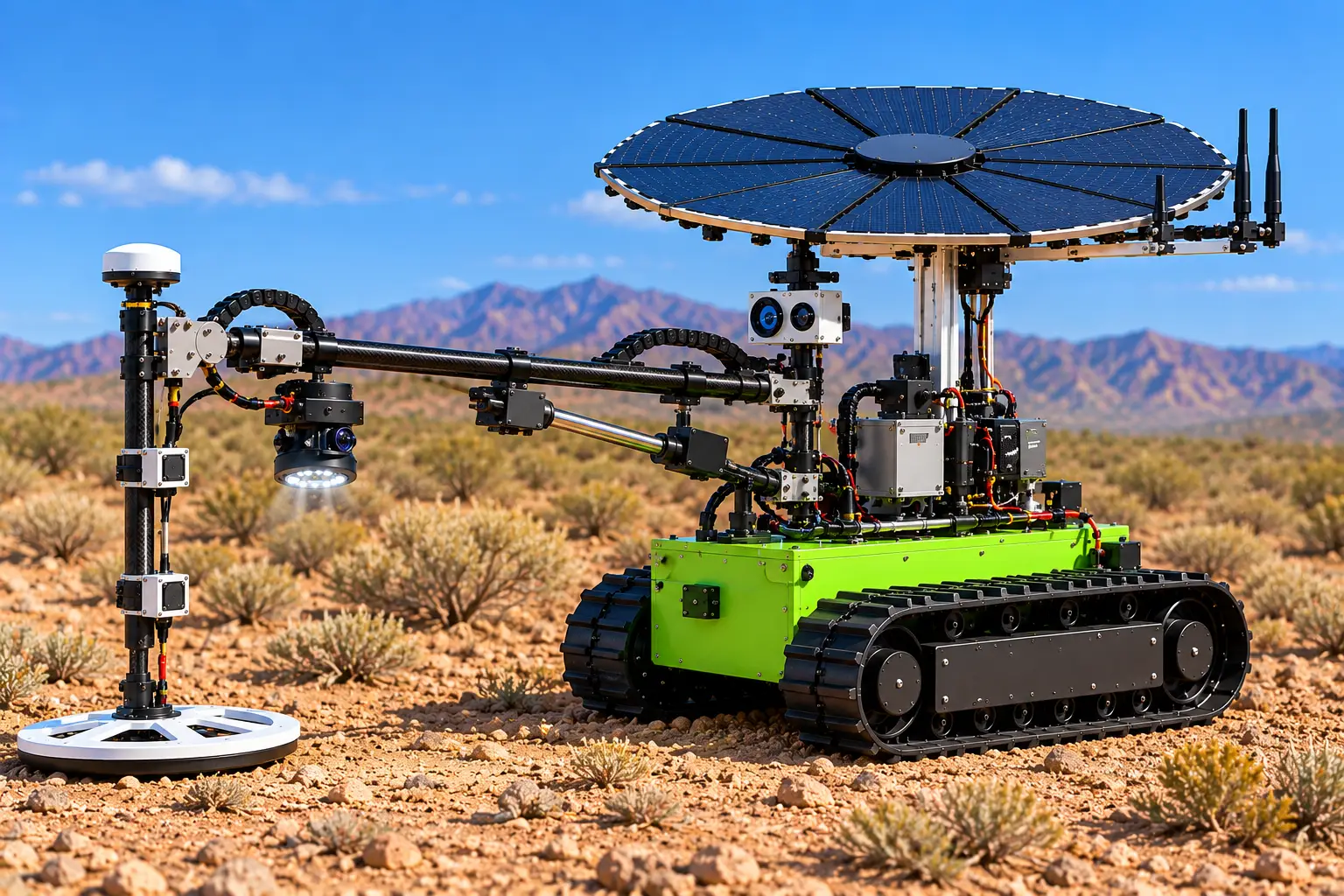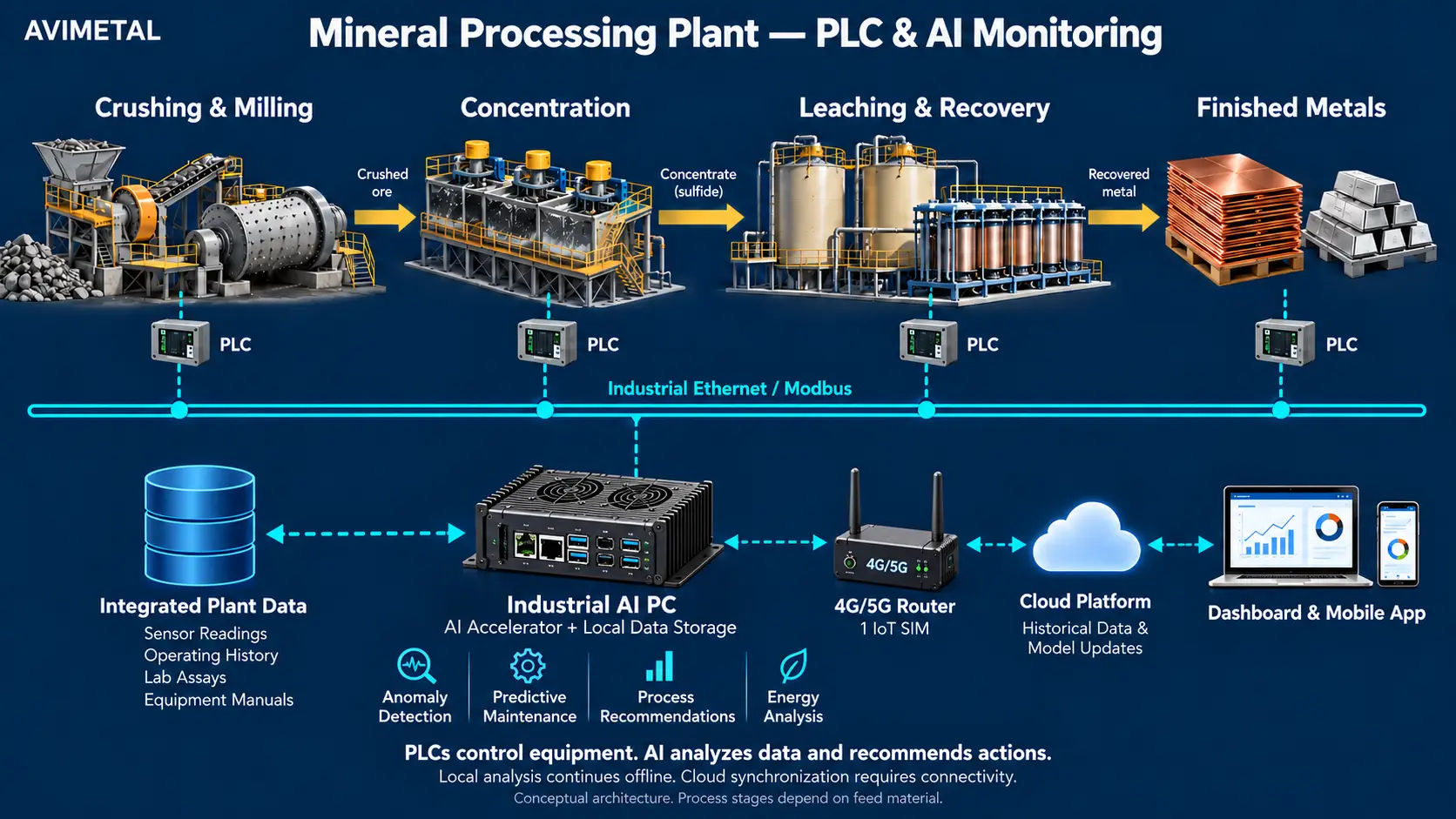
Avimetal’s proposed monitoring architecture combines local machine controls, an industrial AI computer and shared connectivity to help operators understand plant performance and identify problems earlier.
Mineral-processing plants generate valuable information every day. Motor loads, flow rates, tank levels, temperature and laboratory assays all help explain how a process is performing. However, this information often remains scattered across individual machines, control panels and operating records.
Avimetal is developing a concept that brings these data sources together. The objective is to give operators a clearer view of their equipment and support better operating decisions across modular processing plants.
PLC Controls at Each Processing Stage
Programmable logic controllers, or PLCs, manage equipment according to programmed operating sequences and interlocks. Depending on the plant configuration, these controllers can serve crushing, milling, concentration, leaching, electrorefining and electrowinning systems.
Sensors and compatible equipment controllers provide measurements such as:
Motor current, operating status and running hours.
Process temperature, pressure and flow.
Tank levels, pH and other solution measurements.
Equipment faults and maintenance events.
The monitoring network collects these readings while local controls continue to operate the equipment.
An Industrial AI Computer for Plant Analysis
A central industrial computer equipped with a suitable AI accelerator would collect information from the connected equipment and maintain a local operating history.
By combining sensor readings with laboratory assays, maintenance records and equipment documentation, the system could help operators investigate changing process conditions.
Potential applications include detecting unusual equipment behavior, identifying maintenance needs, comparing energy consumption and recommending process adjustments. These functions would require suitable models, reliable measurements and validation against actual plant operation.
For example, increasing motor current combined with declining throughput could prompt an inspection for a blockage, excessive loading or mechanical wear. The system would flag the condition for investigation rather than assume a single cause.
Integrated Data for Better Decisions
Sensor readings alone do not explain every change in mineral-processing performance. Feed composition, particle size and operating practices also influence results.
Connecting laboratory assays and feed records with time-stamped operating data could help operators compare production periods and understand why results differ. Equipment manuals and maintenance histories could provide additional context when investigating alarms.
The quality of the analysis depends on accurate sensors, consistent records and representative data. AI recommendations would support engineering judgment and operator review.
One Shared Connection for Remote Monitoring
Machines operating together at one site do not each need a cellular SIM. They can communicate with a central computer through industrial Ethernet, Modbus or suitable local wireless interfaces.
A shared cellular router with one IoT SIM can then transmit selected reports and alerts to a cloud platform, dashboard or mobile app. Sites without suitable cellular coverage could use another internet connection.
The system would retain operating data locally during communication outages and synchronize it when connectivity returns. Data plans must match the reporting volume, particularly when transferring historical records or model updates.
Local Operation with Remote Visibility
Keeping data collection and AI analysis on site can allow configured monitoring functions to continue during an internet outage. Remote access gives authorized personnel a way to review plant conditions and support troubleshooting when a connection is available.
PLCs would retain equipment control, with dedicated safety systems where required. Changes to operating settings would follow the plant’s approved procedures and authorization requirements.
Avimetal’s goal is to combine modular processing equipment with useful operational information. Through phased testing and validation, this approach could help customers improve maintenance planning, investigate process changes and manage plants with greater visibility.
Avimetal welcomes discussions with industrial automation, AI computing and pilot-site partners interested in developing and validating this concept.