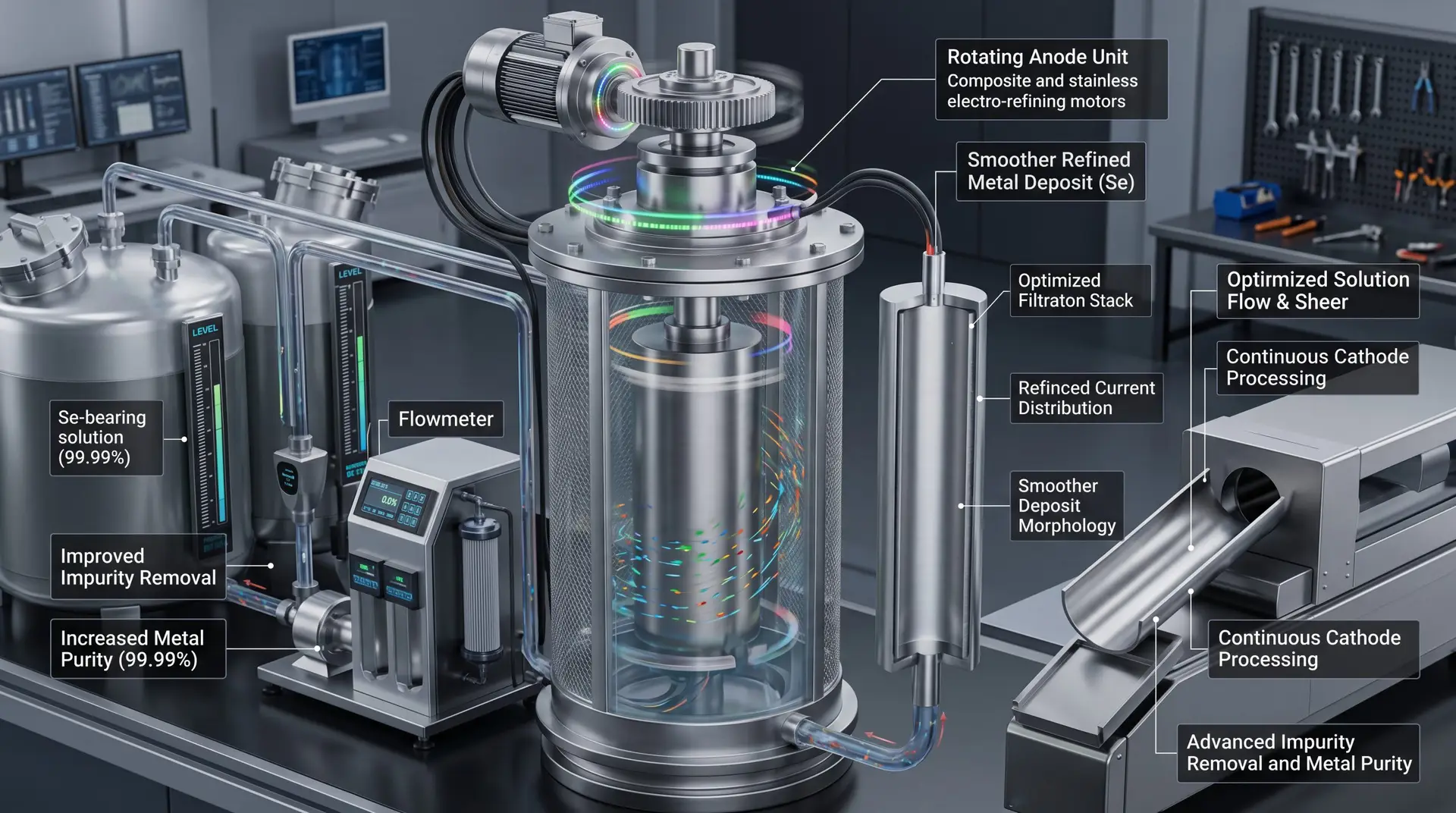
A rotating drum electrorefining system is an advanced electrochemical refining technology designed to improve impurity removal, increase metal purity, enhance current distribution, and produce smoother and denser refined metal deposits through the use of a rotating cylindrical cathode drum combined with soluble metal anodes. The system is based on a similar structural concept to rotating electrowinning technology, but instead of using inert graphite anodes, the electrorefining process uses consumable anodes made from impure copper or selective metal-bearing anodes that dissolve into the electrolyte during operation.
During operation, electrical current passes through the electrolyte solution between the stationary soluble anodes and the continuously rotating cylindrical cathode drum. As the anode material gradually dissolves, metal ions are released into the electrolyte and migrate toward the rotating cathode surface where purified metal is electrochemically deposited. The cathode drum itself is coated or laminated with a conductive metallic surface such as copper, gold, silver, or another selective metal plating layer that serves as the deposition substrate for refined metal growth.
The continuous rotation of the cylindrical cathode creates strong electrolyte circulation and hydrodynamic movement around the deposition surface. This rotational fluid motion significantly improves ion transport, mass transfer efficiency, and current distribution compared to conventional static electrorefining systems. The improved circulation reduces stagnant boundary layers near the electrode surface and continuously refreshes the electrolyte surrounding the cathode drum.
Because of the improved electrolyte movement, the system minimizes concentration polarization, gas bubble accumulation, uneven current density, and localized overheating that commonly occur in conventional flat-plate refining cells. This allows metal ions to deposit more uniformly across the rotating drum surface, producing smoother, denser, and higher-purity refined metal layers with improved crystalline structure and reduced dendrite formation.
The rotating motion also helps prevent scaling, cathode passivation, and impurity entrapment during electrochemical deposition. Since the cathode surface is continuously moving, deposited metal layers remain more evenly distributed and can be more easily removed or harvested through automated scraping or stripping systems without significant interruption to operation.
In copper electrorefining applications, impure copper anodes dissolve into the electrolyte while highly pure copper deposits onto the rotating cathode drum surface. Valuable impurities such as gold, silver, platinum, palladium, selenium, and other precious or rare metals do not fully dissolve and instead accumulate as anode slime or sludge at the bottom of the cell. These byproducts can later be collected and processed separately for precious metal recovery.
The system may also be adapted for refining silver, gold, nickel, cobalt, rare metals, or other specialized alloys depending on electrolyte chemistry and electrode configuration. Different metallic surface coatings can be applied to the rotating drum to optimize adhesion, conductivity, deposit quality, and selective metal recovery performance.
Advanced rotating drum electrorefining systems may incorporate cyclone electrolyte circulation, automated cathode scraping systems, temperature regulation, electrolyte filtration, current density control, gas management systems, and modular multi-cell configurations to maximize refining efficiency and operational stability. The controlled hydrodynamic environment inside the cell improves refining speed while reducing energy consumption and maintenance requirements.
One of the major advantages of the rotating drum electrorefining system is its ability to achieve faster and more efficient purification with superior metal quality compared to conventional static electrorefining technologies. The improved mass transfer and current distribution allow higher production rates while maintaining excellent deposit uniformity and purity.
Because of its ability to combine rotating cathode technology, advanced electrolyte circulation, and efficient electrochemical purification, the rotating drum electrorefining system represents an innovative next-generation refining technology for high-purity metal production, precious metal recovery, hydrometallurgical processing, and advanced industrial refining operations.
Product Family: AVRER Series — 8 Modular Configurations | Rotating-drum cathode + soluble metal anodes · Ultra-high-purity refining for Cu, Ag, Au, Ni, PGM & alloys
| Cell Count | DC Current Range | Cu Deposition Range | Cathode Purity | Drum Cathode |
|---|---|---|---|---|
| 1–8 cells | 200–1,600 A | 0.23–1.83 kg/h | 99.99%+ | Ø500 × 1,500 mm |
Where This Fits in the Avimetal Electrorefining Product Line
Avimetal offers three electrorefining technologies for different production requirements. The Rotating Electrorefining Cell AVRER targets buyers who need the highest possible purity and surface quality on their refined metal.
| Product | Cathode | Anode | Best For |
|---|---|---|---|
| AVER Cyclone ER | Stationary Ti cylinder | Soluble Cu tube | Industrial copper refining at moderate scale |
| AVRER Rotating ER | Rotating drum | Soluble metal anodes | Highest-purity refining · smooth dense deposits · automated harvest |
| AVM-EW-05 Cell Module | Integrated array | Mixed EW + ER | Full containerized installation with both EW and ER |
Model Configurations — Modular Cell Scaling
All cells use a Ø500 × 1,500 mm rotating titanium drum with selectable metallic coating Cu / Au / Ag / Ni. Each cell operates at 200 A and typical 1.5 V refining duty.
| SKU | Cells | Voltage | Current | Power (kW) | Cu Deposition (kg/h) | Drum Cathode |
|---|---|---|---|---|---|---|
| AVRER-1 | 1 | 1.5 V | 200 A | 0.30 | 0.23 | Ø500 × 1,500 mm |
| AVRER-2 | 2 | 1.5 V | 400 A | 0.60 | 0.46 | Ø500 × 1,500 mm |
| AVRER-3 | 3 | 1.5 V | 600 A | 0.90 | 0.69 | Ø500 × 1,500 mm |
| AVRER-4 | 4 | 1.5 V | 800 A | 1.20 | 0.91 | Ø500 × 1,500 mm |
| AVRER-5 | 5 | 1.5 V | 1,000 A | 1.50 | 1.14 | Ø500 × 1,500 mm |
| AVRER-6 | 6 | 1.5 V | 1,200 A | 1.80 | 1.37 | Ø500 × 1,500 mm |
| AVRER-7 | 7 | 1.5 V | 1,400 A | 2.10 | 1.60 | Ø500 × 1,500 mm |
| AVRER-8 | 8 | 1.5 V | 1,600 A | 2.40 | 1.83 | Ø500 × 1,500 mm |
Copper deposition is calculated from Faraday's law at 97% current efficiency typical for high-grade copper electrorefining. For gold refining, the theoretical rate is approximately 1.47 kg/h per cell at the same current, limited by precious-metal feed availability. Cathode drum coatings are selectable for Cu, Au, Ag, Ni, or PGM duty.
Key Features
- Rotating cylindrical cathode: Continuous drum rotation refreshes the boundary layer and produces uniform, smooth, dense deposits with minimal dendrite formation.
- Soluble anode design: Consumable copper or selective metal-bearing anodes dissolve during operation while precious-metal impurities collect as anode slime.
- Ultra-high purity output: 99.99%+ purity is achievable through improved current distribution, reduced concentration polarization, and minimized impurity entrapment.
- Selectable drum coating: Cathode drum can be coated with Cu, Au, Ag, or other selective metal layers matched to the target product.
- Automated cathode harvest: Optional integrated scraping system removes deposited metal continuously without stopping operation.
- Reduced gas bubble accumulation: Rotating motion sweeps gas bubbles away from the cathode surface, reducing voids and uneven deposit thickness.
- Lower energy and faster refining: Improved mass transfer reduces refining time and energy consumption compared with conventional static-plate tank houses.
- Anode slime recovery: Au, Ag, Pt, Pd, Se, and Te slimes collect at the cell bottom and can feed downstream Cyclone EW AVEW for individual recovery.
Typical Applications
| High-Purity Metal Production | Copper refining to LME Grade A 99.99% and beyond; silver refining to London Good Delivery 999.5–999.9; gold refining to four- or five-nines purity; nickel and cobalt cathode for battery-grade applications; PGM purification from impure feedstock |
| Specialty & Advanced Refining | Alloy purification with selective electrolyte chemistry; recycling-grade metal refining from e-waste, battery, and scrap; rare-metal and critical-mineral refining; pilot-scale metal recovery process development; refining ahead of high-purity casting or downstream metal manufacturing |
Commercial Terms & Certifications
| Lead Time | 45 days for AVRER-1 to AVRER-4 · 75 days for AVRER-5 to AVRER-8 · FAT before shipment |
| Warranty | 12 months on workmanship · 24 months on drum cathode, rotational drive, and rectifier · drum coating: 18 months or per-application terms |
| Included Scope | Engineering, integration, FAT with customer-supplied sample anode where possible, on-site install supervision, operator & maintenance training, O&M manuals, first-fill anodes matched to target metal, spare drum coating refurbishment kit |
| Certifications | Engineered by Avimetal · Manufactured by UL, CE, ETL, ISO 9001-certified OEM partners · Rectifier: IEC 60146 / IEC 60519-3 · Control panels UL 508A-listed · Cathode product assayable to LME Grade A copper 99.99%, London Good Delivery Ag / Au, or industry-specific purity standards |
| Payment Terms | 30 / 70 on AVRER-1 to AVRER-4 · 30 / 60 / 10 on AVRER-5 to AVRER-8 deposit / shipment / commissioning · irrevocable letter of credit accepted |
| Recommended Pairings | Upstream anode sources: AVCC Continuous Anode Casting Furnace, smelter matte, scrap copper, e-scrap, recycled bullion · Co-installed: Cyclone Electrowinning System AVEW for anode-slime processing · Downstream: High-Temp Fusion Furnace AVM-HTF-1000, Precious Metal Refining Plant, direct dispatch · Module: Electrowinning / Electrorefining Cell Module AVM-EW-05 |
Ready to Order Electrorefining Cell System?
Tell us about your site and processing needs — our team will recommend the right solution and put together a custom quote.
Request a Quote No commitment required · Response within 1 business day