Traditional placer gold exploration is slow, labor-intensive, and often limited by terrain. Walking miles with handheld detectors or setting up large survey grids takes time, manpower, and cost. But today, a new approach is emerging—autonomous drone-based gold detection systems designed for continuous, high-efficiency surveying.
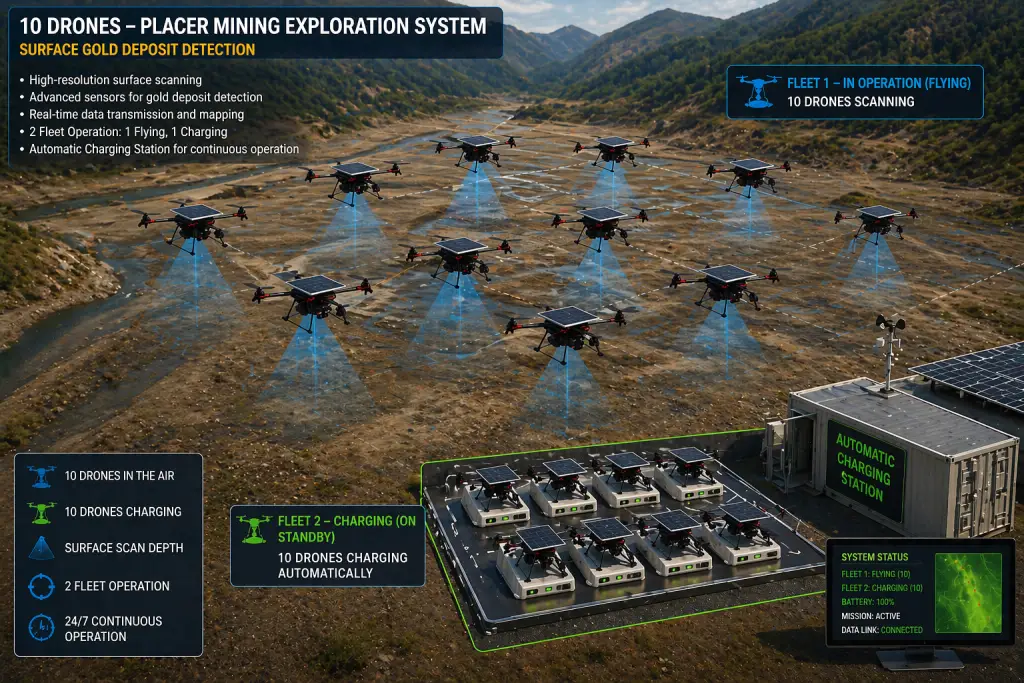
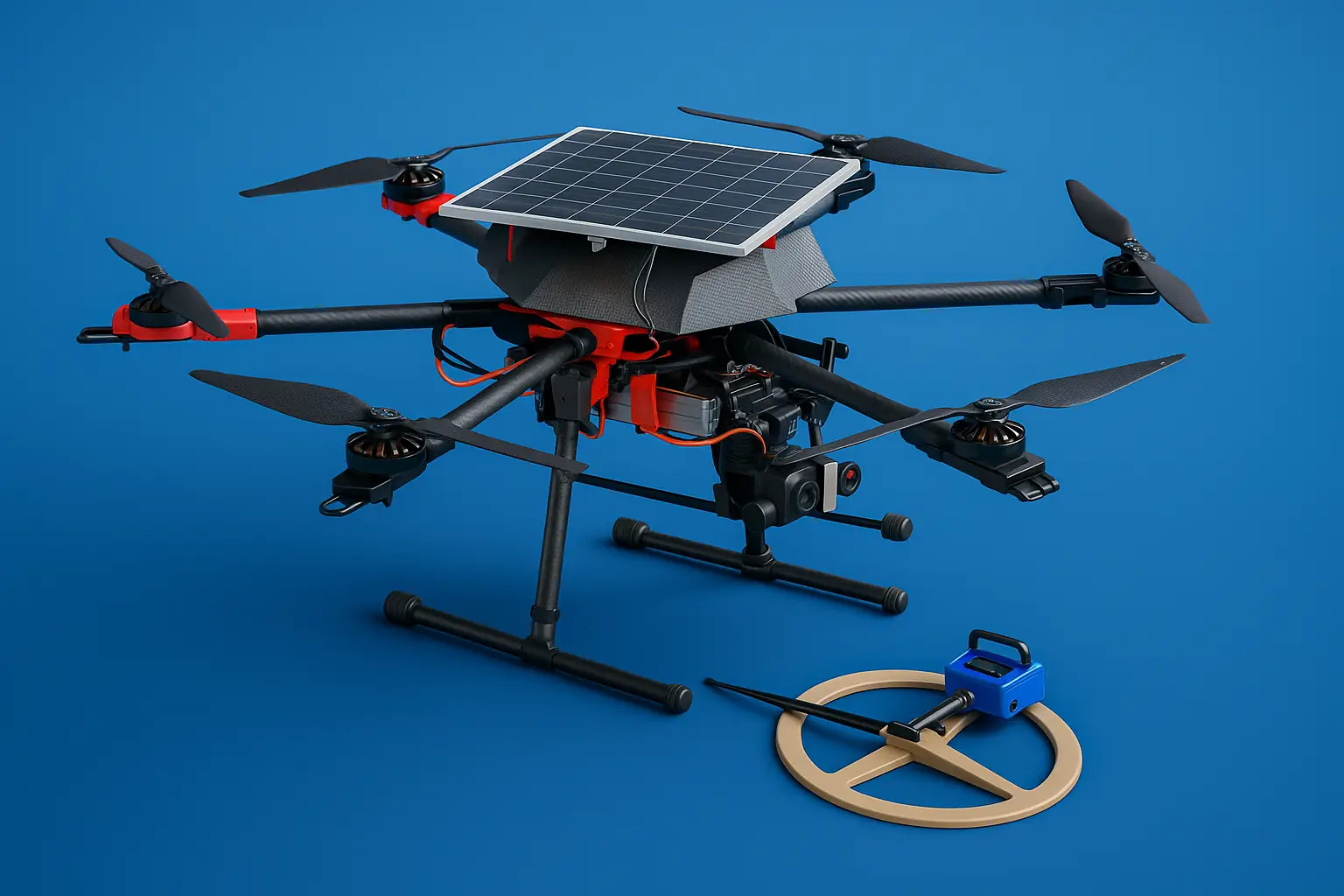
Imagine a fleet of drones equipped with advanced detection sensors, scanning placer deposits from above. Each drone flies at low altitude—typically under 50 feet—allowing precise detection while maintaining stable signal resolution. As the drones move across the terrain, they continuously scan and transmit detection signals in real time, mapping potential gold-bearing zones directly to a central system.
The real innovation is not just the drone—but the fleet system. Instead of relying on a single unit, multiple drones operate in coordination. When one drone’s battery begins to discharge, it automatically returns to base for recharge or swap. At that exact moment, a second drone fleet is deployed, ensuring uninterrupted operation. This creates a 24-hour continuous survey cycle, dramatically increasing coverage and efficiency.
This system eliminates downtime, reduces labor requirements, and enables rapid data collection across large placer fields. In remote or difficult terrain, where traditional exploration is slow and costly, drone fleets can cover ground in hours that would otherwise take days or weeks.
Equally important is operational simplicity. By maintaining low-altitude flight profiles, the system is designed to operate within practical field constraints, avoiding complex high-altitude aviation requirements while focusing on precision, safety, and ease of deployment.
The result is a smarter way to explore: faster identification of gold-rich zones, real-time mapping, and scalable deployment. As mineral exploration moves toward automation and data-driven decision making, drone-based surveying is no longer experimental—it’s becoming essential.
The future of placer gold exploration is not on foot. It’s in the air, coordinated, continuous, and autonomous.