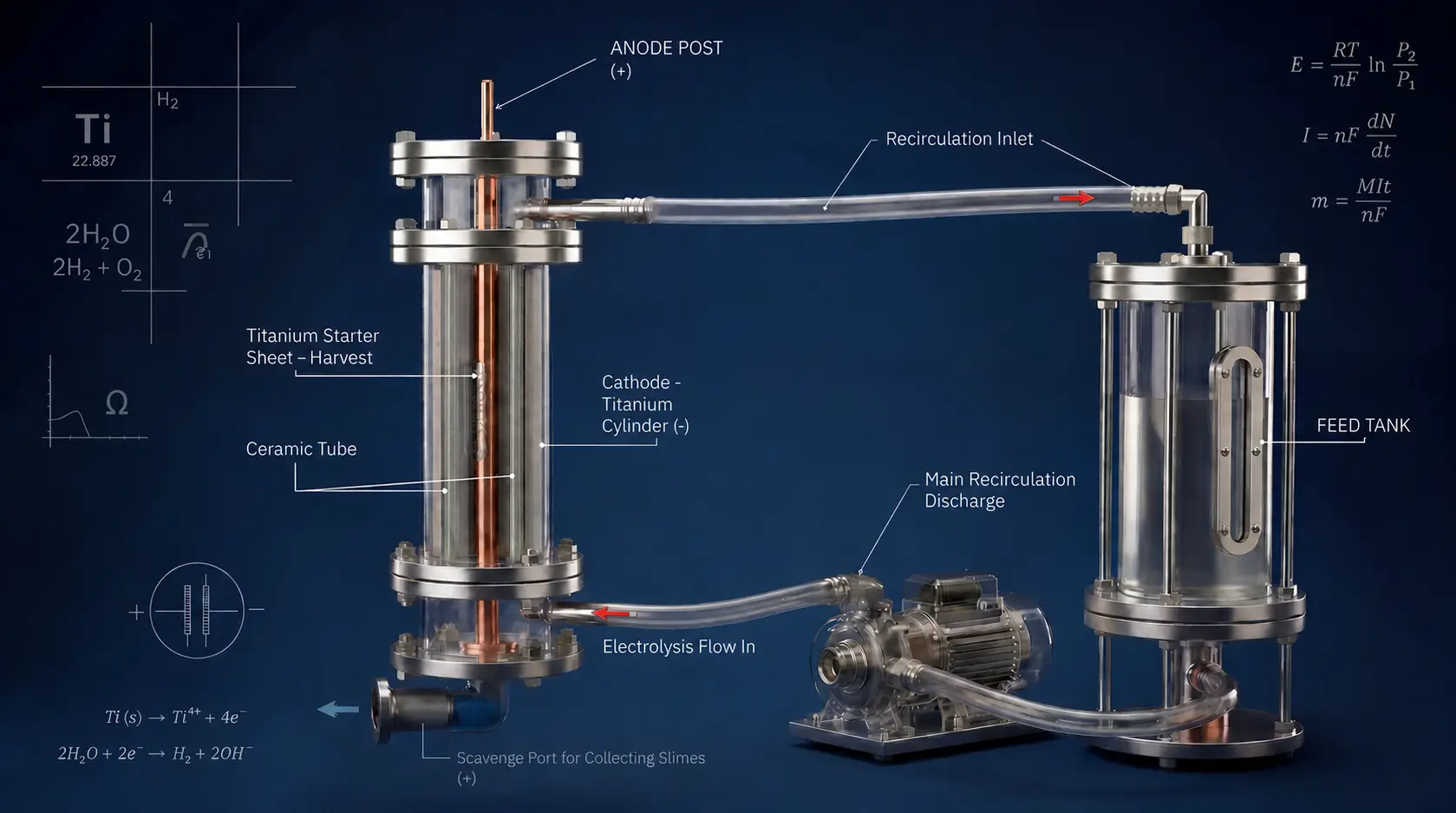
Avimetal’s Cyclone Electrorefining System is an advanced metal refining technology designed to improve on conventional flat-plate electrorefining. It uses a vertical cylindrical cell with controlled cyclone-style electrolyte circulation to increase ion movement, improve mass transfer, and support more uniform metal deposition. The system is designed to selectively dissolve copper or other base-metal anodes, recover high-purity refined metal at the cathode, and collect valuable noble-metal byproducts such as gold, silver, and PGMs as anode slimes for further recovery. It offers potential benefits including faster refining, better deposition quality, improved slime management, higher recovery efficiency, and a more compact modular refining system.
Product Family: AVER Cells + AVCC Anode-Casting Furnaces | Complete anode-to-cathode flow for copper, PGM & precious-metal refining · Titanium cyclone cathode · LME Grade A output
| Cell Cathode | DC Current Per Cell | Anode Casting | Cathode Purity | Lead Time |
|---|---|---|---|---|
| Ø250 × 500–2,000 mm | 300–800 A | 100–300 kg / batch | 99.99% Cu (LME) | 30–60 days |
How the System Works
- Smelter feed or concentrate plus collector metal Cu / Ni / Fe is melted in the AVCC continuous casting furnace.
- The melt is drawn through the Intelligent Traction Machine to form a tubular copper anode Ø140 mm × 1,200 mm with 10–15 mm wall thickness.
- The anode is loaded into an AVER cyclone electrorefining cell with a titanium starter-sheet cathode.
- DC current dissolves copper from the anode and deposits pure copper on the cathode as 99.99% LME Grade A copper.
- Noble metals such as Au, Ag, Pt, and Pd do not dissolve and settle at the bottom as anode slimes.
- Slimes are processed in the Cyclone Electrowinning System AVEW to selectively recover individual precious metals.
AVER Cyclone Electrorefining Cells
Three vertical-cyclone cell sizes are available, all with 250 mm cathode diameter and different heights and current ratings. Cells stack in modular arrays for higher production.
| SKU | Cathode | Anode Holder | DC Power | Cu Deposition | Standard Features |
|---|---|---|---|---|---|
| AVER-250-500 | Ti, Ø250 × 500 mm + starter sheet | Ø140 mm | 0–6 V / 300 A | ~0.34 kg Cu/h · ~8 kg/day | Anode filter, Ti starter sheet |
| AVER-250-1000 | Ti, Ø250 × 1,000 mm + starter sheet | Ø140 mm | 0–6 V / 500 A | ~0.57 kg Cu/h · ~14 kg/day | Anode filter, Ti starter sheet |
| AVER-250-2000 | Ti, Ø250 × 2,000 mm + starter sheet | Ø140 mm | 0–6 V / 800 A | ~0.91 kg Cu/h · ~22 kg/day | Anode filter, Ti starter sheet |
Copper deposition is calculated from Faraday's law at typical 95% current efficiency for electrorefining duty. Actual production depends on solution chemistry, anode purity, and operating temperature. Cells deploy in modular arrays of 10–40 cells per industrial bank.
AVCC Continuous Anode Casting Furnace
The AVCC furnace melts concentrate plus collector metal Cu / Ni / Fe and continuously casts tubular copper anodes for the AVER cells.
| SKU | Capacity | Max Power | Input Voltage | Cooling Water | Anode Output |
|---|---|---|---|---|---|
| AVCC-100 | 100 kg / batch | 90 kW | 3-phase 480 / 380 V, 50–60 Hz | ≥0.2 MPa · ≥15 L/min | Tubular Cu · Ø140 mm · wall 12–15 mm |
| AVCC-300 | 300 kg / batch | 160 kW | 3-phase 480 / 380 V, 50–60 Hz | ≥0.2 MPa · ≥15 L/min | Tubular Cu · Ø140 mm · wall 12–15 mm |
Intelligent Traction Machine
| Rated Power | 1.5 kW |
| Torque | 5 N·m |
| Operation Mode | 10-inch touch screen HMI |
| Driver | Bipolar constant-phase current interpolation drive |
| Control System | PLC, Siemens / Allen-Bradley class |
| Pressure Wheel | 4-wheel combination, adjustable, dual-mode operation |
Key Features
- Cyclone-flow refining: Vertical vortex circulation accelerates ion migration and improves efficiency compared with traditional flat tank houses.
- Titanium cathode: Long-life starter sheet with easy cathode peel-off for high-purity copper harvest.
- Tubular anode design: Continuous-cast tubular copper anodes Ø140 mm deliver uniform dissolution and stable current distribution.
- Anode filter cartridge: Captures anode slimes for separate precious-metal recovery with no manual cell cleaning between batches.
- Integrated upstream casting: AVCC furnace pre-casts anodes in-line with refining demand, eliminating the need to source anodes externally.
- Continuous slime to AVEW recovery: Anode slimes feed directly into Avimetal's Cyclone EW system for Au / Ag / Pt / Pd selective recovery.
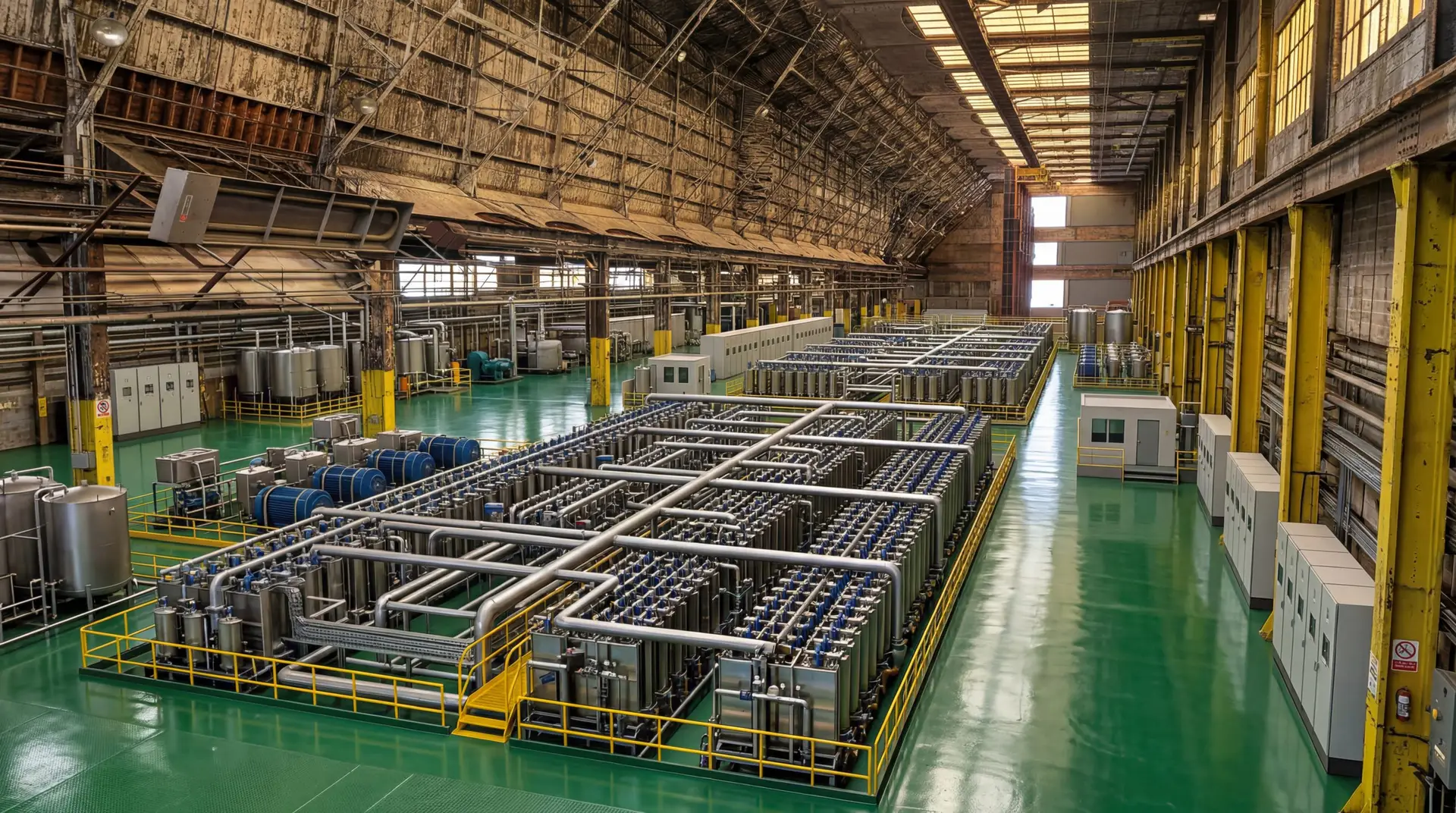
- Modular & scalable: Stack cells into 10-, 20-, or 40-cell industrial banks and pair with one or multiple AVCC furnaces to match throughput.
- Closed-loop operation: Electrolyte and cooling water both recirculate, reducing effluent for ESG-compliant operations.
Commercial Terms & Certifications
| Lead Time | 30 days for individual AVER cells · 60–90 days for AVCC furnaces and full systems · FAT before shipment |
| Warranty | 12 months on workmanship · 24 months on titanium cathode bodies, AVCC induction coil & rectifier · 18 months on intelligent traction machine |
| Included Scope | Engineering, integration, FAT, on-site install supervision, refractory lining & sintering supervision AVCC, operator & maintenance training, O&M manuals, first-fill anode set, spare titanium starter-sheet set, complete seal/gasket kit |
| Certifications | Engineered by Avimetal · Manufactured by UL, CE, ETL, ISO 9001-certified OEM partners · AVCC induction system to IEC 60519 · Rectifiers to IEC 60146 · Control panels UL 508A-listed · Cathode product assayable to LME Grade A copper 99.99%; slimes processable to London Good Delivery for Au and Ag |
| Payment Terms | 50 / 50 on individual AVER cells · 30 / 70 or 30 / 60 / 10 on AVCC furnaces and full systems · irrevocable letter of credit accepted |
| Recommended Pairings | Upstream: smelter matte, copper scrap, e-scrap, refractory PGM concentrate · Co-installed: Cyclone Electrowinning System AVEW for anode-slime processing · Downstream: High-Temp Fusion Furnace AVM-HTF-1000 for casting commercial shapes, Precious Metal Refining Plant, direct cathode dispatch · Module: Electrowinning / Electrorefining Cell Module AVM-EW-05 for full containerized installation |
Ready to Order Cyclone Electrorefining Cell System?
Tell us about your site and processing needs — our team will recommend the right solution and put together a custom quote.
Request a Quote No commitment required · Response within 1 business dayCyclone Electrorefining vs. Traditional Plate-Type Electrorefining
| Item | Our Cyclone Electrorefining Cell | Traditional Plate-Type ER Cell |
|---|---|---|
| Cell design | Cyclone/turbulent flow cell | Flat plate cathode/anode cell |
| Chemical use | About 20% of conventional use | Higher chemical consumption |
| Metal transfer | High mass transfer from cyclone flow | Slower ion transfer, boundary-layer limitation |
| Processing speed | Faster reaction and recovery | Slower refining cycle |
| Footprint | Compact, modular, stackable | Large tanks and plate banks required |
| Operation | Continuous, automated operation possible | Batch-style plate handling required |
| Labor | Lower labor, less manual handling | Higher labor for plate removal/stripping |
| Maintenance | Fewer plate-handling issues | More maintenance on plates, contacts, spacing |
| Energy efficiency | Lower resistance and better flow efficiency | Higher energy loss in large bath systems |
| Low-grade recovery | Strong recovery from low-grade/complex feed | Less efficient for very low concentration metals |
| Scalability | Easy to scale by adding cyclone modules | Scale requires larger buildings and tank farms |
| Environmental impact | Less chemical waste, less sludge, easier closed-loop system | More chemical waste and larger wastewater load |
| Main advantage | High efficiency, low chemical use, small footprint | Proven conventional large-scale process |
| Competitive position | Advanced modular U.S. refining technology | Traditional Plate ER system |