Examining locally manufactured suction-dredge designs that deliver retail-grade performance at a fraction of the imported price.
Suction dredging remains one of the most cost-effective methods of recovering placer gold and heavy minerals from alluvial deposits. While imported systems from established equipment manufacturers typically retail in the USD 3,000 to 4,000 range for small-diameter units, a locally fabricated equivalent built around an off-the-shelf engine and a hand-built sluice can be assembled for roughly USD 1,000. For mining professionals evaluating capital deployment in remote operations, that delta is significant. This article walks through the technical components, capacity tiers, and operational characteristics of these low-cost dredge systems.
System Architecture
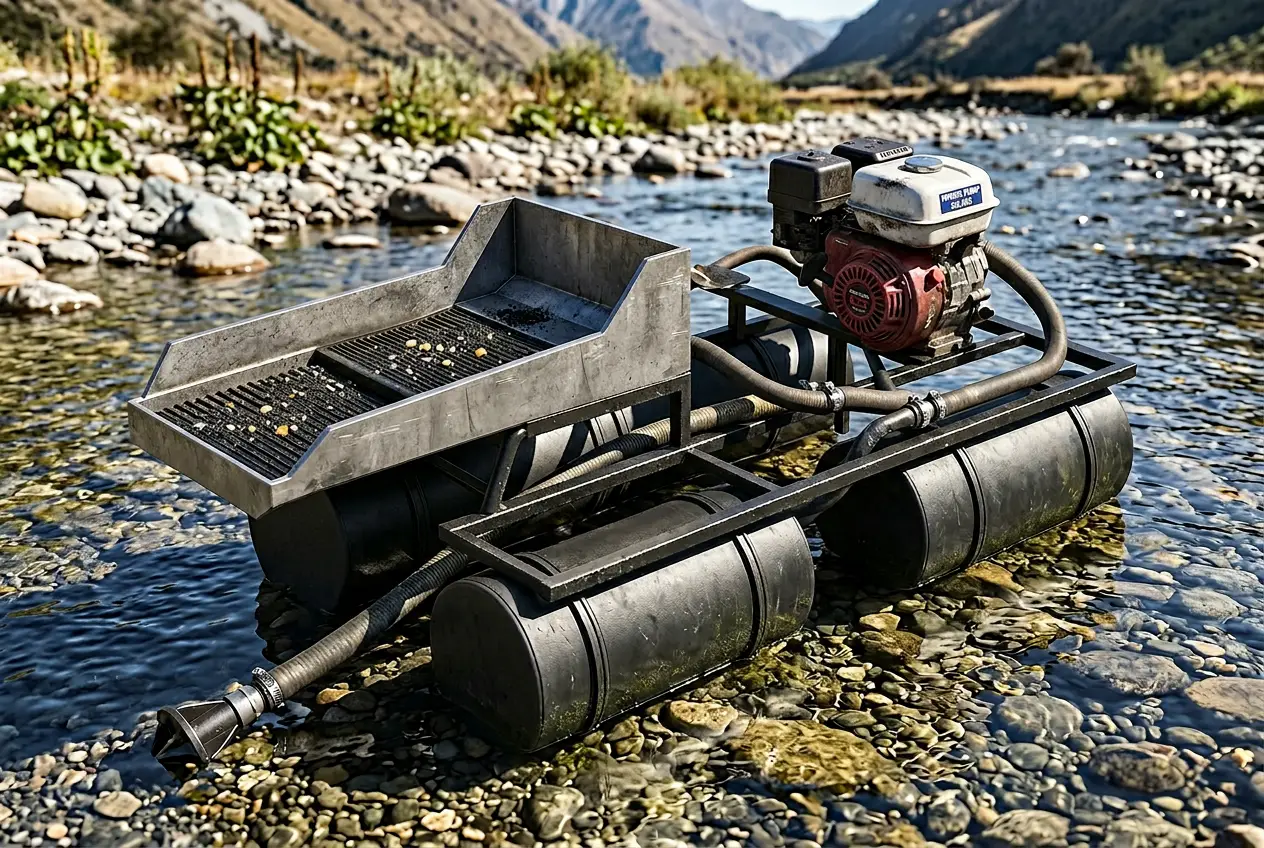
A small-diameter suction dredge is mechanically straightforward. A gasoline engine drives a centrifugal water pump, which generates the suction needed to lift a slurry of water, sand, gravel and target minerals up through a flexible hose and discharge it across a sluice box. The sluice, lined with rubber matting, captures heavy particles by gravity while lighter material washes off the tail. A platform of inflatable floats or sealed plastic drums keeps the assembly stable on the water surface; a compressor feeds the diver hookah line for sub-surface dredging.
The five core subassemblies are:
- Power and pump unit — A Honda (or equivalent) gasoline engine paired with a centrifugal pump and integrated air compressor. This is typically the only imported component and accounts for roughly half of the total build cost (~USD 500).
- Sluice box and frame — Locally fabricated from sheet metal or marine plywood with a welded or bolted frame (~USD 100).
- Riffle matting — Ribbed rubber mats inside the sluice that trap fine values; supplied as a kit component (~USD 150).
- Hose, piping and jet nozzle — Suction hose, discharge piping and a hydraulic jet nozzle that loosens compacted gravel ahead of the intake (~USD 100).
- Flotation — Either factory inflatable rubber pontoons or, where unavailable, two recycled 200-litre plastic drums lashed to the frame (~USD 150).
Built to specification, the complete assembly delivers performance that is mechanically equivalent to imported units in the same size class — the cost saving comes from substituting local labour and locally available frame materials for the value embedded in a pre-fabricated dealer product.
Small-Class Units: 2, 3 and 4 Inch
Throughput in a suction dredge is governed primarily by hose diameter and pump capacity. The three common sizes in the small-class range are summarised below.
|
Hose Diameter
|
Throughput
|
Fuel Use
|
Special Application
|
|---|---|---|---|
|
2 inches
|
2 M3 / Hour
|
1.3 L / Hour
|
Single-operator prospecting
|
|
3 inches
|
3 M3 / Hour
|
1.5 L / Hour
|
Small crew, shallow placer
|
|
4 Inches
|
4 M3 / Hour
|
1.7 L / Hour
|
Established artisanal site
|
Fuel consumption scales modestly with size, which makes the 4-inch unit attractive on a per-cubic-metre basis where fuel logistics are manageable. In remote sites where every litre is hand-carried, the 2-inch and 3-inch configurations offer better operational flexibility despite lower absolute throughput.
Large-Class Configuration: 100 TPH Platform
For operations that have proven a deposit and need to scale, the same architecture extrapolates to a much larger float. A platform of eight to sixteen 200-litre drums supports four to eight high-banking sluice boxes arranged in parallel, fed by a heavy-duty submersible pump that exceeds 120 kg in dry weight. Total throughput on this configuration is in the order of 100 tons per hour, and the complete system can be assembled for under USD 10,000.
Operationally, the submersible pump is positioned directly over an expected pit hole and lowered to the working face, where it ingests gravel and sand at depth without the need for a diver on a hookah line. The parallel sluice arrangement increases retention surface area, which is essential at the higher mass flow — a single sluice box at 100 TPH would simply wash heavies over the tail. For professional operators, this is the configuration to evaluate against a small mechanical wash plant: similar throughput, an order of magnitude lower capital outlay, and far simpler logistics.
Considerations for Operators
Three factors warrant attention when specifying a low-cost dredge for a commercial operation. First, the engine and pump assembly is the single point of failure; sourcing a reputable brand and stocking spares (impellers, seals, fuel filters) is non-negotiable. Second, sluice geometry — slope, water velocity and riffle spacing — has a much larger effect on recovery than dredge size; a poorly tuned sluice will lose values regardless of throughput. Third, regulatory compliance for suction dredging varies sharply by jurisdiction, particularly around riverbed disturbance and turbidity limits, so operators should validate permitting before committing capital.