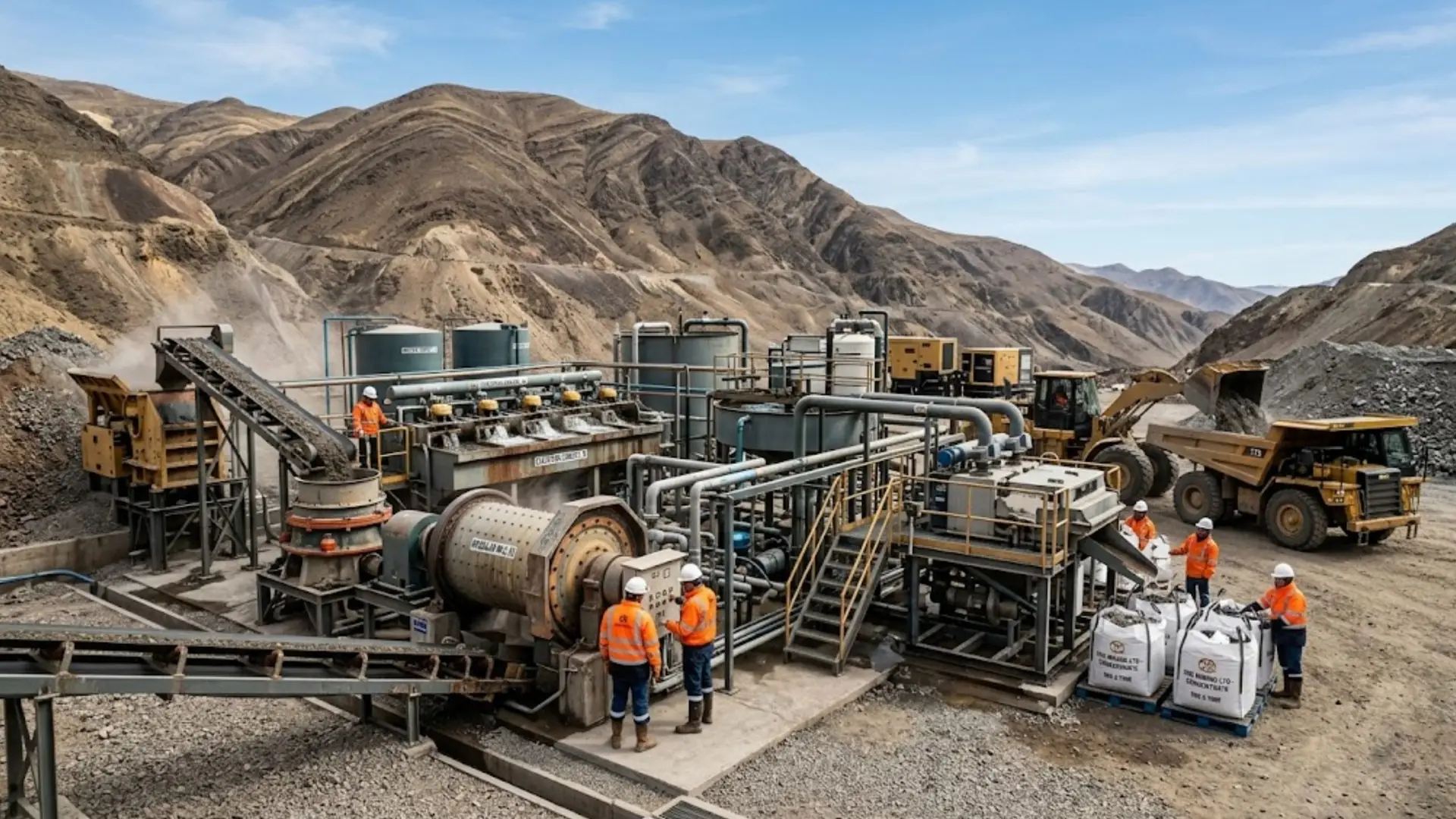
Cost of Setting Up a Gold Refinery
Introduction
If you are planning to enter the gold processing business, one of the first questions you will ask is simple: what is the Cost of Setting Up a Gold Refinery? This is the right question, because a refinery is not just a building with a few machines. It is a full industrial system that needs the right process, equipment, utilities, safety controls, skilled labor, and working capital.
For mining companies, industrial buyers, engineers, and investors, the real challenge is not only the initial spending. The bigger issue is whether the refinery can run efficiently, produce high-purity gold, recover costs, and generate strong margins over time. A poor plant design can increase losses, waste energy, and create compliance problems. A well-planned refinery can become a strong long-term asset.
This article explains the Cost of Setting Up a Gold Refinery in practical business terms. You will learn the refining process, plant capacity options, major equipment, energy consumption, cost ranges, profitability, and why many buyers now prefer modular and scalable systems for regions with strong artisanal and small-scale mining activity such as Peru, Bolivia, Mexico, Colombia, Ghana, Tanzania, Indonesia, and the Philippines.
Table of Contents
| Sr# | Headings |
|---|---|
| 1 | Overview of Cost of Setting Up a Gold Refinery |
| 2 | Why Market Demand Is Growing in Target Countries |
| 3 | What Determines Refinery Setup Cost |
| 4 | Step-by-Step Gold Refining Process |
| 5 | Equipment Required for a Gold Refinery |
| 6 | Plant Capacity Options from 10 to 1000 TPD |
| 7 | Energy Consumption Details |
| 8 | Cost Estimation: Low, Medium, and High Investment Cases |
| 9 | Operating Costs and Working Capital |
| 10 | ROI and Profitability Analysis |
| 11 | Comparison with Traditional Methods |
| 12 | Environmental and Compliance Benefits |
| 13 | Real-World Use Cases and Applications |
| 14 | How to Reduce Risk Before Investing |
| 15 | Conclusion |
| 16 | FAQs |
1. Overview of Cost of Setting Up a Gold Refinery
The Cost of Setting Up a Gold Refinery depends on how large the plant is, what feed material you will process, the target purity, local labor and utility costs, environmental regulations, and whether you choose a basic setup or a more advanced modular system.
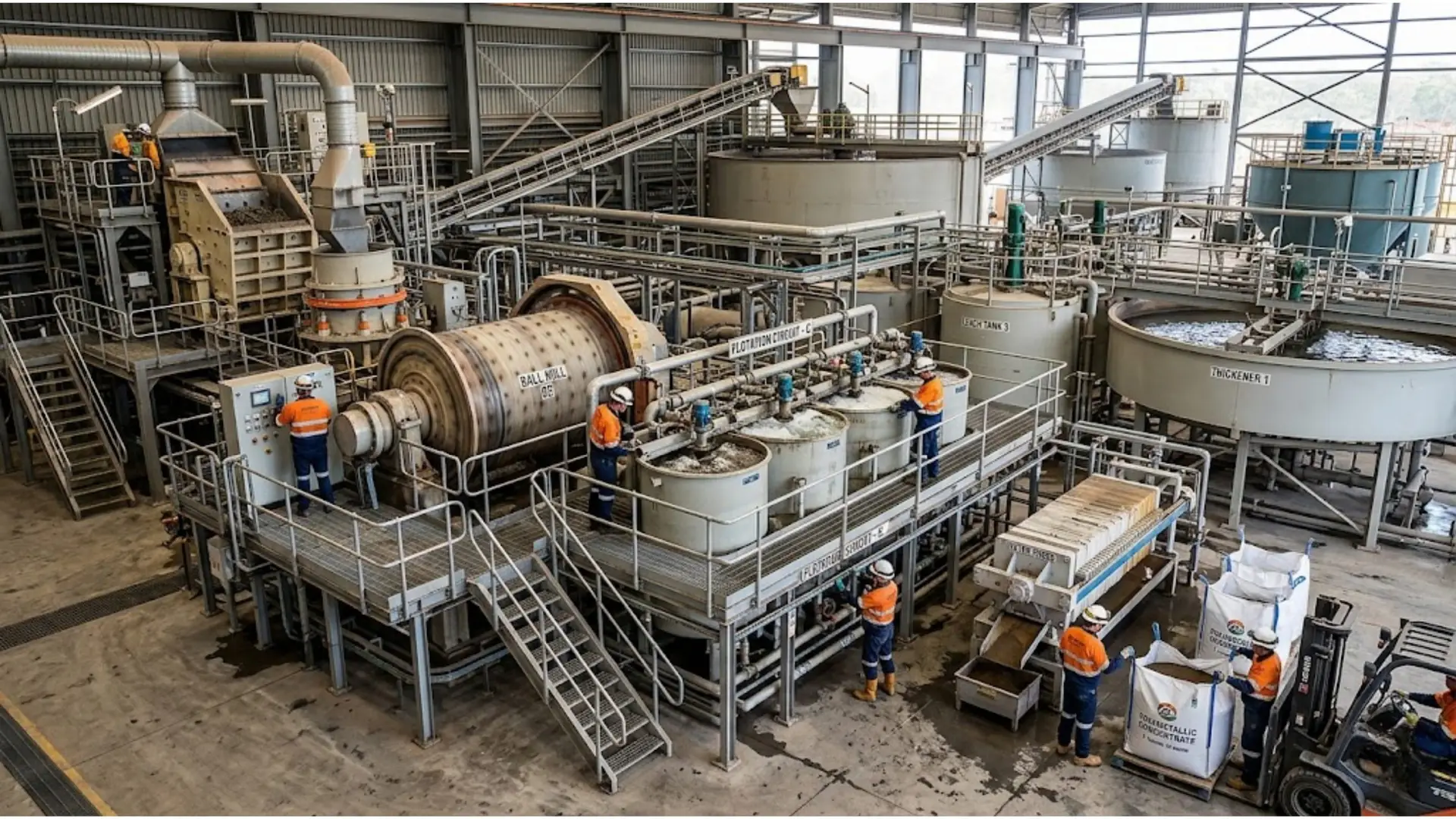
A small refinery may process dore bars, gold concentrates, scrap jewelry, or recovered industrial material. A larger plant may include pretreatment, smelting, chemical refining, wastewater treatment, assay laboratory, and automated casting systems. This means capital cost can vary widely.
In simple terms, setting up a gold refinery is like building a water purification plant. If you only want to clean a small amount of water, your setup can stay compact and affordable. But if you need to purify large volumes, remove more impurities, test quality, and meet strict safety standards, the system becomes much larger and more expensive. Gold refining works in a similar way. The cleaner and more controlled you want the final output to be, the higher the investment.
2. Why Market Demand Is Growing in Target Countries
The Cost of Setting Up a Gold Refinery makes more sense when you look at where demand is strongest. In countries with many small and medium-scale mining operations, local refining capacity is often limited. That creates a strong business opportunity.
Peru, Bolivia, Mexico, and Colombia
These Latin American markets have many small mines and gold trading networks. In many cases, raw or semi-processed gold moves through several intermediaries before final refining. A local or regional refinery can reduce transport, improve traceability, and capture more value close to the source.
Ghana and Tanzania
These African markets are important because of strong artisanal and small-scale gold production. Many miners need reliable processing partners that can deliver fair recovery, tested purity, and compliant documentation. A modern refinery can serve miners, traders, and exporters.
Indonesia and the Philippines
These markets also show strong potential due to dispersed mining activity, island-based logistics, and demand for compact or modular systems. In such regions, a plant that is easy to install, expand, and maintain can have a major advantage.
For marketing, these countries are important because buyers there usually want practical, robust, and scalable plants, not overcomplicated systems. They care about cost, recovery, compliance, and support after installation.
3. What Determines Refinery Setup Cost
When people ask about the Cost of Setting Up a Gold Refinery, they often think only about machinery price. In reality, the total cost includes much more.
Feed Material Type
If your feed is clean dore bars, refining is more straightforward. If your feed includes concentrates, scrap, or mixed metal inputs, you may need more pretreatment, more chemicals, and better emissions handling.
Purity Target
Producing 99.5% gold is simpler than producing 99.99% or higher. Higher purity usually requires tighter control, more stages, better assay capability, and cleaner handling systems.
Plant Size
A 10 TPD plant is very different from a 1000 TPD facility. Civil works, utility systems, automation, staffing, and environmental controls increase sharply as capacity grows.
Technology Choice
A simple batch-based refinery can cost less upfront. A modular automated plant costs more but often performs better in consistency, safety, and labor efficiency.
Location
Power costs, land price, transport cost, import duty, and local construction cost all affect final investment. A plant in a remote mining region may require extra logistics and backup systems.
Compliance Requirements
Environmental permits, air filtration, wastewater treatment, chemical storage, and worker safety systems can add a major portion to project cost, especially in regulated export markets.
4. Step-by-Step Gold Refining Process
A clear process plan is essential when calculating the Cost of Setting Up a Gold Refinery.
H3: 1. Feed Reception and Sampling
The first step is receiving the raw material. This may include dore bars, scrap gold, concentrate, or other gold-bearing material. The material is weighed, logged, and sampled for testing.
H3: 2. Assay and Analysis
The feed is analyzed to determine gold content and impurities such as silver, copper, lead, zinc, and iron. This step is critical because it affects refining route, chemical use, and expected recovery.
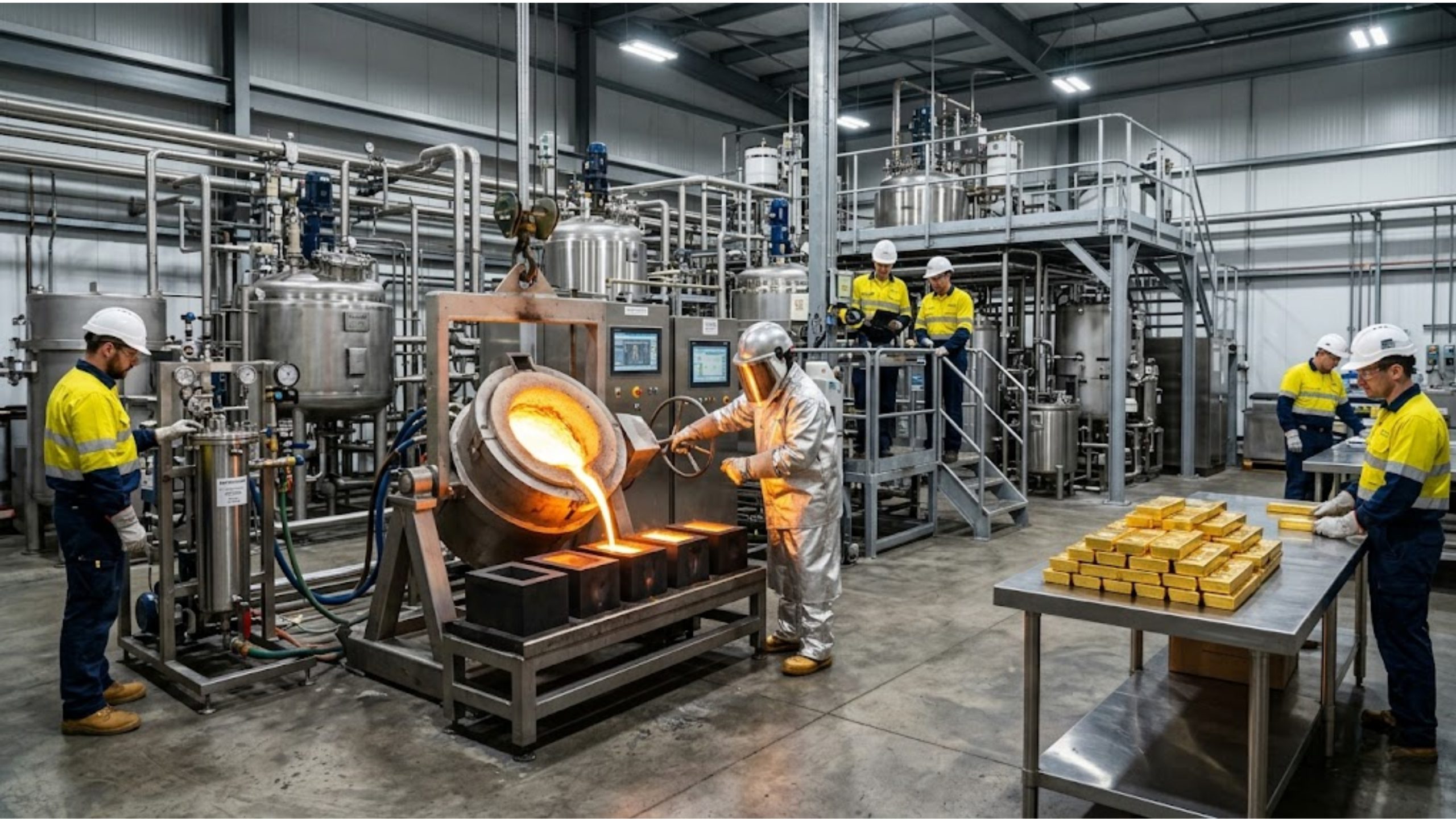
H3: 3. Melting and Smelting
The material is heated in furnaces to separate valuable metal from slag and unwanted solids. Fluxes may be added to help impurity removal.
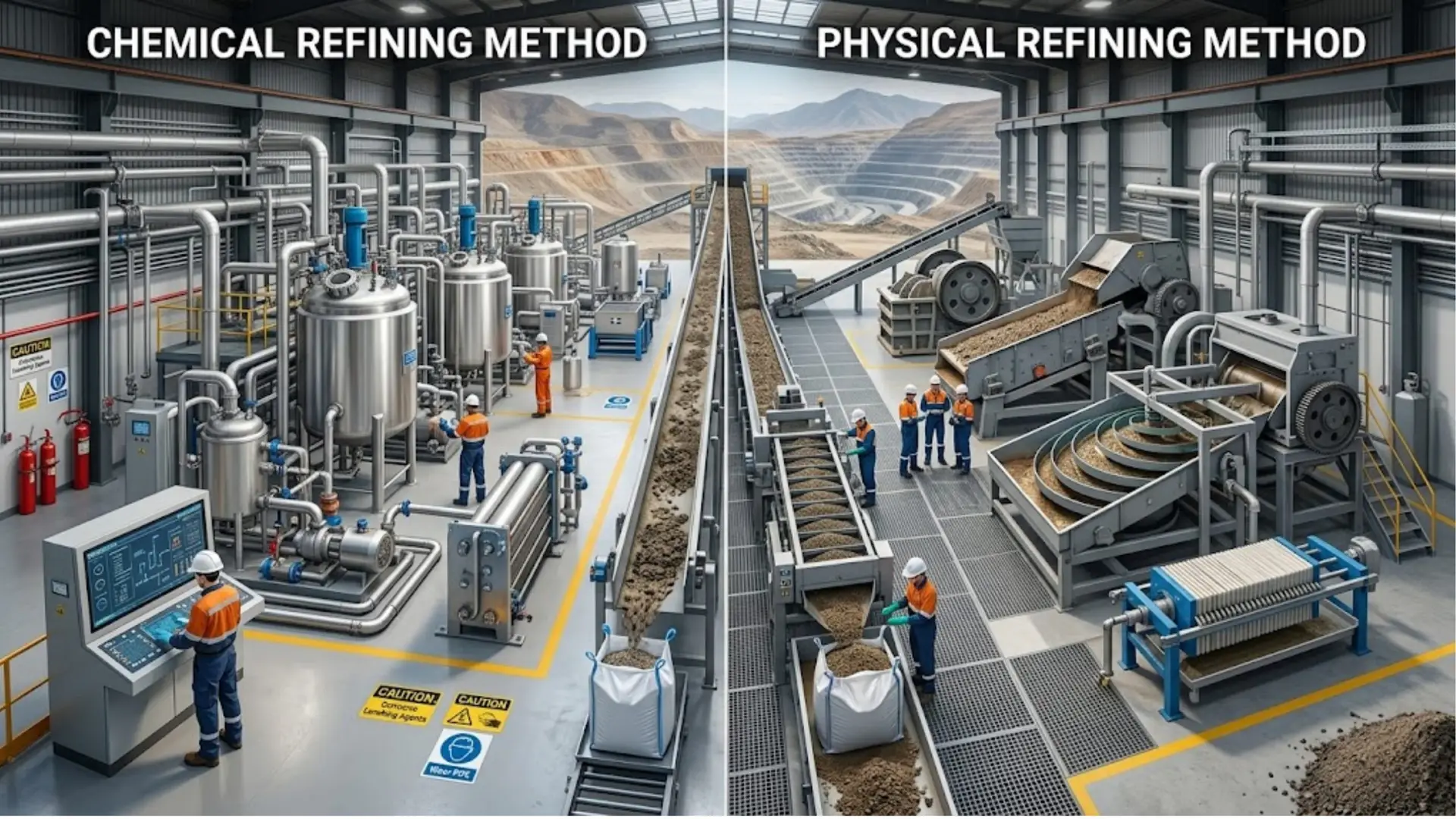
H3: 4. Chemical Refining
Depending on the process, the gold may go through chlorination, aqua regia refining, electrorefining, or other chemical purification methods. This stage removes remaining impurities and raises purity.
H3: 5. Filtration and Separation
Solutions and residues are filtered, washed, and separated. Precious metals still present in residues may be recovered in additional steps.
H3: 6. Precipitation or Electrowinning
Gold is recovered from solution and converted into solid form. This may happen through precipitation or electrochemical recovery depending on the chosen process.
H3: 7. Drying and Melting of Refined Gold
The recovered gold powder or sponge is dried and melted again to produce final bars, grain, or cast products.
H3: 8. Final Assay and Packaging
Final quality testing confirms the product meets required purity standards. The gold is then cast, stamped, documented, and prepared for sale or further use.
This process needs discipline. Even a small error in sampling, chemical dosing, or filtration can reduce recovery and affect revenue.
5. Equipment Required for a Gold Refinery
The equipment list directly shapes the Cost of Setting Up a Gold Refinery. A typical setup may include:
-
Feed handling and weighing systems
-
Sampling and assay equipment
-
Crucibles and melting furnaces
-
Smelting furnace or induction furnace
-
Chemical leaching or refining reactors
-
Filtration units
-
Precipitation tanks
-
Electrowinning or electrorefining cells
-
Drying ovens
-
Casting machines or molds
-
Dust collection and ventilation system
-
Fume scrubbers
-
Water treatment system
-
Wastewater neutralization tanks
-
Laboratory testing instruments
-
Power distribution and control panels
-
Safety systems and chemical storage units
In a more advanced plant, you may also add automation, SCADA-based controls, bar coding, digital assay records, and modular skid-mounted units for faster installation.
6. Plant Capacity Options from 10 to 1000 TPD
Capacity has one of the biggest impacts on the Cost of Setting Up a Gold Refinery. Buyers should choose capacity based on realistic feed availability, not only ambition.
10–50 TPD
This is suitable for pilot plants, regional traders, small mining groups, and early-stage investors. It offers lower capital risk and faster installation. It is often the best entry point for markets with fragmented small mines.
50–200 TPD
This range suits growing mining districts and established gold buyers who need regular throughput. It allows better economies of scale while staying manageable.
200–500 TPD
This is a mid-to-large industrial setup. It requires stronger utility infrastructure, a larger site, more staff, and better process control. It can support contract refining for multiple suppliers.
500–1000 TPD
This level is for large integrated operations or major regional hubs. It requires significant capital, full compliance systems, and consistent feed supply. It can deliver strong output, but only if raw material availability is secure.
For many target countries, the smartest strategy is often to begin with a modular 30–100 TPD plant and scale later. This reduces initial exposure while creating room for growth.
7. Energy Consumption Details
Energy cost is a key part of the Cost of Setting Up a Gold Refinery because refining involves heat, pumping, ventilation, drying, and process control.
Main Energy Consumers
-
Melting and smelting furnaces
-
Drying ovens
-
Pumps and agitators
-
Ventilation and fume extraction
-
Electrorefining or electrowinning systems
-
Lighting, control systems, and laboratory equipment
Typical Consumption Pattern
A small plant may have moderate electrical demand but higher fuel cost if it relies on burners for smelting. A larger plant may shift more to electric furnaces and automated systems, increasing power infrastructure needs.
As a broad planning guide, energy use rises with feed complexity, moisture level, impurity removal stages, and environmental controls. A basic small-scale refinery can operate with a modest connected load, while a large industrial plant may need a dedicated substation and backup generator support.
Why Energy Planning Matters
High energy use can quietly destroy margins. A refinery with cheap equipment but poor thermal efficiency may look affordable on paper yet become expensive to run. Good furnace insulation, heat-efficient cycles, smart motor sizing, and process integration can reduce long-term cost significantly.
For remote mining regions, hybrid systems with generators, solar support, or fuel-efficient thermal units may improve reliability.
8. Cost Estimation: Low, Medium, and High Investment Cases
The Cost of Setting Up a Gold Refinery can be grouped into three broad cases.
Low Investment Case
A small basic plant with limited automation, batch processing, simple assay capability, and lower output may start from approximately USD 150,000 to USD 500,000.
This kind of setup may work for small traders, pilot operations, or early-stage buyers. However, it may have lower throughput, more manual handling, and limited environmental systems.
Medium Investment Case
A more professional modular refinery with better furnaces, chemical refining units, assay lab, filtration, emissions control, and wastewater treatment may range from USD 500,000 to USD 2 million.
This is often the most practical range for serious industrial buyers in high-demand mining regions. It balances capacity, compliance, and cost.
High Investment Case
A large industrial refinery with advanced automation, full laboratory systems, strong safety infrastructure, higher capacity, and integrated environmental treatment can range from USD 2 million to USD 10 million or more.
Large projects may go beyond this range depending on land, construction, localization, and export-grade compliance requirements.
These estimates usually include plant systems and core infrastructure planning, but total project cost may still increase after adding land, building, taxes, logistics, spare parts, training, and working capital.
9. Operating Costs and Working Capital
Initial plant cost is only part of the investment. The Cost of Setting Up a Gold Refinery should always be reviewed together with operating cost.
Main Operating Cost Items
-
Chemicals and fluxes
-
Electricity and fuel
-
Labor
-
Maintenance and spare parts
-
Assay and laboratory consumables
-
Waste treatment
-
Safety and compliance
-
Packaging and transport
-
Insurance and administration
Working Capital
A refinery also needs cash flow for raw material purchases, stock handling, payroll, and regular consumables. If you buy gold-bearing feed and refine it for resale, working capital can become a major requirement.
A common mistake is spending all available funds on equipment and leaving too little for operations. A refinery without enough working capital may sit idle even if the plant itself is technically complete.
10. ROI and Profitability Analysis
Investors care deeply about whether the Cost of Setting Up a Gold Refinery can be recovered in a reasonable timeframe.
Revenue Drivers
Profitability depends on:
-
Throughput
-
Gold recovery rate
-
Refining fee per kilogram
-
Purity premium
-
Metal loss control
-
Operating cost per ton or per kilogram
Example ROI Logic
A plant that processes a steady volume of gold-bearing material and charges refining fees while also earning from by-product recovery can create strong cash flow. If feed supply is secure and losses are low, a medium-scale refinery may recover capital in 1.5 to 4 years. In highly efficient cases with good local supply and premium output, payback may be even faster.
What Improves ROI
Higher utilization, better recovery, lower chemical consumption, and stable energy cost improve profitability. Modular expansion also helps because you do not overspend on unused capacity in the beginning.
What Hurts ROI
Poor sampling, irregular feed supply, weak compliance, frequent downtime, and high metal losses can seriously damage returns.
For mining companies, a refinery can also create indirect value by reducing dependence on third-party processors and improving control over sales quality.
11. Comparison with Traditional Methods
A modern refinery should not be judged only by purchase price. The better question is how it compares with traditional refining methods.
Traditional Methods
Older systems often rely on manual handling, open chemical use, low process control, and less reliable testing. They may work at small scale, but they usually create inconsistency and higher losses.
Modern Refinery Systems
Modern systems offer:
-
Better purity control
-
Higher recovery
-
Improved worker safety
-
Cleaner emissions handling
-
More accurate assay
-
Better traceability
-
Lower long-term cost per unit
This is similar to comparing hand washing with a modern industrial cleaning line. Both may clean the product, but the controlled system is faster, safer, and more repeatable.
For buyers serving export markets, modern plants are far more attractive because traceability and compliance matter as much as output.
12. Environmental and Compliance Benefits
Environmental performance is now an important part of the Cost of Setting Up a Gold Refinery.
A cheaper plant without proper controls may create fumes, wastewater, chemical handling risk, and disposal problems. That may lead to fines, shutdowns, export issues, and reputational damage.
Key Environmental Benefits of Modern Plants
Closed handling systems reduce worker exposure. Fume scrubbers improve air quality. Wastewater treatment units help neutralize process liquids before discharge or reuse. Dust collection systems reduce contamination inside the facility.
In many target markets, environmental compliance is becoming more important, especially where gold supply chains are under global scrutiny. A clean plant can support responsible sourcing claims and improve trust with commercial partners.
13. Real-World Use Cases and Applications
The Cost of Setting Up a Gold Refinery becomes easier to justify when you look at how different buyers use these plants.
Mining Companies
A mining group can install a refinery near its processing operation to reduce transport of semi-processed material and improve control over final product quality.
Regional Gold Buyers
A buyer who collects material from small miners can refine locally, capture more margin, and provide faster settlement to suppliers.
Export-Oriented Businesses
A refinery can support export-grade gold production with better documentation, testing, and packaging.
Industrial Recycling Operations
Gold-bearing scrap from electronics, jewelry, and industrial residues can also be refined, creating another revenue stream.
Government-Linked or Cooperative Hubs
In some regions, centralized refining hubs can improve formalization of small-scale mining and create more transparent trade channels.
These use cases are highly relevant in Peru, Bolivia, Mexico, Colombia, Ghana, Tanzania, Indonesia, and the Philippines, where many small mines need trusted downstream processing.
14. How to Reduce Risk Before Investing
Before finalizing the Cost of Setting Up a Gold Refinery, you should reduce technical and commercial risk.
Check Feed Availability
Do not size the plant based on optimistic assumptions. Confirm real feed volume and quality.
Choose Scalable Design
A modular setup lets you start smaller and expand once supply is proven.
Ask for Process Guarantees
Suppliers should explain recovery expectations, purity targets, utility needs, and support terms.
Review Local Compliance Early
Environmental and chemical permits should be considered before installation, not after.
Plan Training and Service
Even a good plant fails if operators are not trained. Ongoing support matters.
Evaluate Supplier Credibility
Look for practical engineering capability, industrial experience, and clear communication. A supplier that understands mining conditions in emerging markets can often deliver better results than one offering only standard catalog equipment.
For buyers looking for professional consultation, plant planning, or modular refinery solutions, it is helpful to work with a supplier that understands both engineering and market realities.
Website: https://avimetal.com/
Address: C/O AINFOX, 2060 Faith Industrial Dr., Buford, GA 30518
Email: jgim@avimetal.com
Text Message / WhatsApp / Telegram: +1 470 5648883
Conclusion
The Cost of Setting Up a Gold Refinery depends on much more than machinery price. It is shaped by capacity, feed type, refining method, energy use, environmental controls, and the long-term business model. For mining companies, engineers, industrial buyers, and investors, the best refinery is not always the cheapest one. It is the one that delivers reliable purity, strong recovery, controlled operating cost, and scalable profitability.
In high-demand small-mine markets such as Peru, Bolivia, Mexico, Colombia, Ghana, Tanzania, Indonesia, and the Philippines, a well-designed modular refinery can create a strong competitive advantage. If you plan carefully, match capacity to feed supply, and invest in the right process design, a gold refinery can become a profitable and durable industrial asset.
FAQs
1. What is the average Cost of Setting Up a Gold Refinery?
The average Cost of Setting Up a Gold Refinery can range from USD 150,000 for a small basic setup to USD 10 million or more for a large industrial refinery. The final cost depends on capacity, automation level, refining technology, environmental systems, and local installation conditions.
2. What plant capacity is best for a new gold refinery project?
For new projects, 10 to 100 TPD is often a practical starting range, especially in regions with many small mines. It reduces capital risk and allows easier expansion later. The right capacity should always be based on confirmed feed availability.
3. Is a gold refinery profitable?
Yes, a gold refinery can be profitable if feed supply is stable, recovery is high, and operating costs are controlled. Profit comes from refining fees, purity premiums, by-product recovery, and lower dependence on third-party processors. Many medium-scale plants can achieve payback within 1.5 to 4 years under good operating conditions.
4. What are the biggest operating costs in a gold refinery?
The largest operating costs usually include chemicals, electricity or fuel, labor, maintenance, assay testing, and waste treatment. In remote mining regions, logistics and backup power can also become major cost factors.
5. How can I reduce the Cost of Setting Up a Gold Refinery without hurting quality?
You can reduce cost by choosing a modular plant design, matching capacity to actual feed supply, using energy-efficient equipment, and avoiding oversized infrastructure in the first stage. A phased investment approach often gives better results than building too large too early.
Read more: https://avimetal.com/blogs/