Electrostatic Separation in Mineral Processing
Introduction
Many mining companies lose value because fine minerals are difficult to separate efficiently with water-based or older gravity methods alone. If you’re looking for an Electrostatic Separation in Mineral Processing Guide, you’ll find that these techniques can be especially beneficial when you are working with dry climates, remote sites, rising energy costs, or ores that contain very small differences in conductivity.
That is where Electrostatic Separation in Mineral Processing becomes important. It gives you a dry, selective, and often cost-effective way to separate valuable minerals from gangue based on electrical conductivity. For mining companies, plant owners, engineers, and investors, this technology can create a stronger business case by improving recovery, reducing water dependence, and making low-to-medium scale operations more practical.
This article explains how Electrostatic Separation in Mineral Processing works, where it fits in a modern plant, what equipment is required, what it costs, how profitable it can be, and why demand is rising in mining regions such as Peru, Bolivia, Mexico, Colombia, Ghana, Tanzania, Indonesia, and the Philippines.
Table of Contents
| Sr# | Headings |
|---|---|
| 1 | Overview of Electrostatic Separation in Mineral Processing |
| 2 | Why This Technology Matters for Modern Mining |
| 3 | How Electrostatic Separation Works |
| 4 | Step-by-Step Process Explanation |
| 5 | Minerals Commonly Processed with Electrostatic Separation |
| 6 | Equipment List for an Electrostatic Separation Plant |
| 7 | Plant Capacity Options from 10 to 1000 TPD |
| 8 | Energy Consumption Details |
| 9 | Cost Estimation for Different Project Sizes |
| 10 | ROI and Profitability Analysis |
| 11 | Comparison with Traditional Mineral Separation Methods |
| 12 | Environmental Benefits |
| 13 | Real-World Use Cases and Applications |
| 14 | How to Select the Right Plant for Your Site |
| 15 | Conclusion |
| 16 | FAQs |
1. Overview of Electrostatic Separation in Mineral Processing
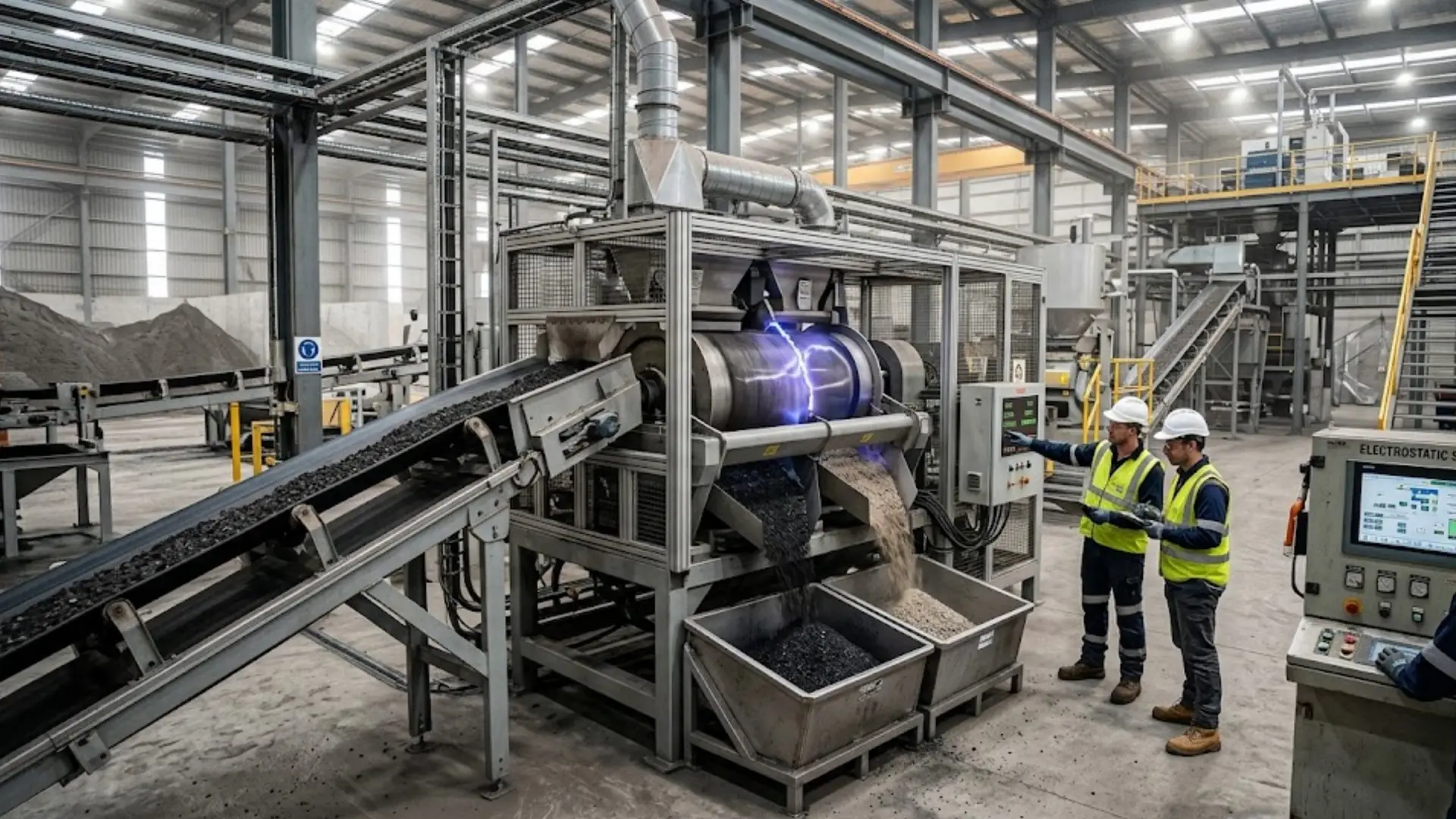
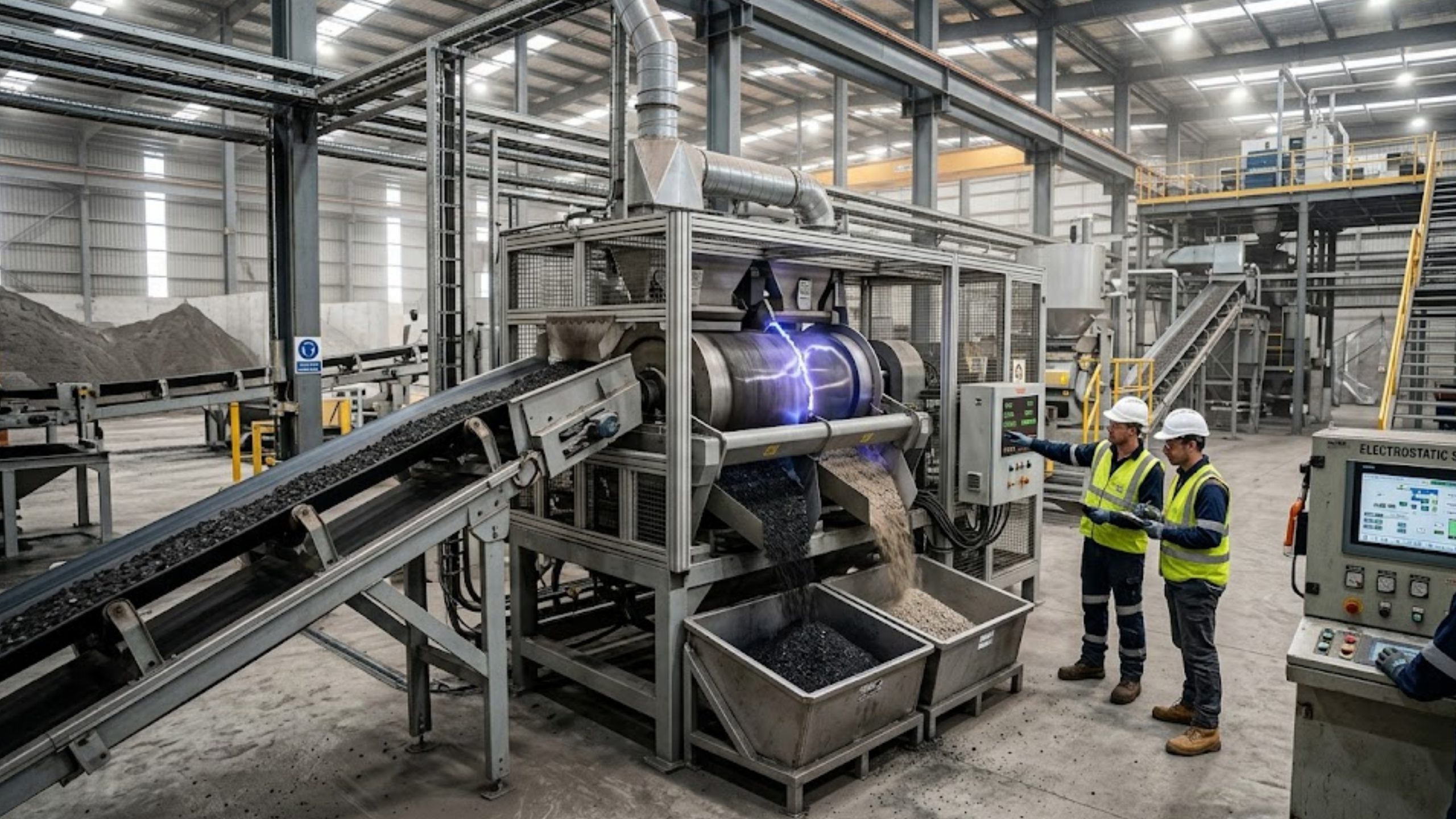
Electrostatic Separation in Mineral Processing is a dry separation method that uses differences in electrical conductivity between mineral particles. When mineral feed passes through a charged electric field, conductive and non-conductive particles respond differently. This allows the system to split valuable minerals from waste or to separate one valuable mineral from another.
In simple terms, think of it like a smart sorting system. Instead of using only size or density, the separator looks at how each particle behaves electrically. That makes it highly useful for heavy mineral sands, industrial minerals, rare earth-related feed preparation, and metallic ores that have suitable conductivity contrast.
For many plants, this method works best after crushing, grinding, drying, and sizing. It is usually not a replacement for every other process, but it can be a powerful part of a complete flowsheet.
2. Why This Technology Matters for Modern Mining
Mining today is under pressure from every side. Buyers want cleaner concentrates. Investors want faster payback. Operators want lower water use. Regulators want better environmental performance. In this environment, Electrostatic Separation in Mineral Processing offers practical value.
It is especially attractive in regions where small and mid-sized mines need modular, lower-water processing solutions. In countries such as Ghana, Tanzania, Peru, and the Philippines, many mines operate in locations where water supply, tailings handling, and utility infrastructure are limited. A dry process can reduce complexity and improve project feasibility.
This technology also helps when you are trying to upgrade feed before further refining. A better feed grade means lower downstream processing cost. That can improve margins across the whole plant, not just in one unit operation.
3. How Electrostatic Separation Works
At its core, Electrostatic Separation in Mineral Processing depends on one simple principle: different minerals conduct electricity differently.
When dry mineral particles are exposed to an electric field, conductive particles lose or gain charge quickly and follow one path, while non-conductive particles retain charge differently and follow another path. The separator then collects these streams separately.
Key Technical Principle
Conductive minerals such as rutile, ilmenite, and some sulfide-bearing particles react differently from non-conductive minerals such as quartz, zircon, feldspar, or silica-rich gangue.
An Easy Analogy
You can compare the process to filtering mixed objects with a magnet, but more advanced. A magnet separates based on magnetic behavior. Electrostatic separation does something similar, but instead of magnetism, it uses electrical response. It is like running mixed grains through a smart electric filter that recognizes how each particle behaves under charge.
Important Operating Condition
The feed must be dry and properly sized. Moisture reduces separation efficiency because water interferes with charge transfer. That is why drying is a critical part of the process.
4. Step-by-Step Process Explanation
A successful Electrostatic Separation in Mineral Processing plant depends on good preparation. The separator itself is important, but feed quality controls the final result.
Step 1: Ore Receiving and Primary Crushing
Run-of-mine ore or pre-concentrated mineral feed enters the plant. Large material is reduced to a manageable size using jaw or cone crushers.
Step 2: Grinding and Liberation
The material is ground to liberate valuable minerals from gangue. Liberation is essential because locked particles cannot be separated properly.
Step 3: Screening and Classification
The feed is screened into a controlled particle size range. Oversized and ultra-fine material can lower separator performance, so tight classification improves selectivity.
Step 4: Drying
Moisture is removed using rotary dryers, fluid bed dryers, or similar systems. This is one of the most critical stages in Electrostatic Separation in Mineral Processing.
Step 5: Feed Conditioning
The dry feed may be conditioned for temperature, surface cleanliness, and flow consistency. Stable feed means stable separation.
Step 6: Electrostatic Separation
The feed enters the electrostatic separator, where particles pass through a charged field or over a charged roll. Conductive and non-conductive particles split into separate streams.
Step 7: Product Collection
Separated fractions are collected as concentrate, middlings, and tailings. Middlings can often be reprocessed to improve total recovery.
Step 8: Final Upgrading or Blending
Concentrates may be polished further or blended to meet customer specifications for smelting, refining, ceramics, glass, or industrial mineral applications.
5. Minerals Commonly Processed with Electrostatic Separation
Electrostatic Separation in Mineral Processing is widely used where dry, conductivity-based separation is possible.
Common Applications Include
Heavy mineral sands are one of the best-known examples. Ilmenite, rutile, zircon, and monazite-bearing feed often goes through magnetic and electrostatic circuits for final upgrading.
Industrial minerals also benefit from this technology. Feldspar and quartz separation is a common case where low iron content is important for glass and ceramics.
In some metallic ore circuits, the technology can support pre-concentration or cleaning stages when mineral surfaces and conductivity differences are favorable.
Typical Minerals
-
Ilmenite
-
Rutile
-
Zircon
-
Quartz
-
Feldspar
-
Monazite
-
Cassiterite in selected circuits
-
Conductive mineral concentrates from dry feed streams
For industrial buyers, this matters because a cleaner product often commands better market pricing and lower refining penalties.
6. Equipment List for an Electrostatic Separation Plant
A complete Electrostatic Separation in Mineral Processing setup usually includes upstream and downstream support equipment, not just the separator.
Core Equipment List
-
Ore hopper and feeders
-
Jaw crusher or cone crusher
-
Ball mill or rod mill
-
Vibrating screens
-
Air classifier or size control unit
-
Rotary dryer or fluid bed dryer
-
Dust collection system
-
Electrostatic separator
-
High-voltage power supply unit
-
Conveyors and transfer chutes
-
Product bins for concentrate, middlings, and tailings
-
Control panel and automation system
-
Sampling and quality control station
Support Systems
You may also need bag filters, heat source units, backup generators, and enclosed handling systems depending on local power stability and environmental requirements.
For buyers planning expansion, a modular layout is often better because you can scale sections without replacing the whole plant.
7. Plant Capacity Options from 10 to 1000 TPD
Plant sizing should match ore type, mine life, budget, and market demand. Electrostatic Separation in Mineral Processing can be designed for small, medium, or large operations.
10–50 TPD
This range suits pilot plants, small mines, bulk sample programs, and specialty mineral projects. It is common where you want to prove recovery before major expansion.
50–200 TPD
This is often ideal for emerging miners in target markets such as Bolivia, Colombia, Ghana, and Tanzania. It balances capital cost with commercial output.
200–500 TPD
This size works well for established mineral processors and contract beneficiation plants. It allows better automation and lower unit cost per ton.
500–1000 TPD
Large operations use this capacity where feed consistency, logistics, and product demand justify full-scale investment. At this level, plant design must focus heavily on automation, dust handling, and feed stability.
Capacity Selection Rule
If your ore is variable, start smaller with room for expansion. If your deposit is stable and market access is secure, a larger integrated system may deliver stronger long-term returns.
8. Energy Consumption Details
Energy use depends on drying load, throughput, feed moisture, ore hardness, and plant design. In most cases, the dryer and comminution circuit consume more energy than the separator itself.
Where Energy Is Used
Crushing and grinding use mechanical energy to liberate particles.
Drying often becomes the biggest energy load, especially in humid regions or when feed arrives wet.
Electrostatic separation units use high-voltage electrical systems, but their direct power draw is usually moderate compared to thermal drying equipment.
Typical Energy Considerations
A small plant with dry feed may operate with relatively low total consumption. A larger plant handling wet material in tropical climates will need much higher dryer energy input.
For many projects, a practical benchmark is to review energy in three blocks:
-
Comminution energy
-
Drying energy
-
Separation and auxiliaries
If you want better economics, focus first on feed moisture reduction before the dryer, heat recovery, insulation, and efficient motors.
9. Cost Estimation for Different Project Sizes
The cost of Electrostatic Separation in Mineral Processing varies widely based on capacity, automation, drying requirement, ore preparation, and civil works.
Low-Cost Range
A small 10–50 TPD plant with basic support systems, limited automation, and simple site preparation can fall into the low investment range. This is suitable for pilot-scale or entry-level production.
Medium-Cost Range
A 50–200 TPD commercial plant with better controls, reliable drying, dust collection, and modular structure falls into the medium investment range. This is often the sweet spot for growing miners.
High-Cost Range
A 200–1000 TPD plant with full automation, high-capacity drying, advanced material handling, and engineered environmental controls falls into the high investment range.
Main Cost Drivers
Ore moisture increases drying cost.
Feed variability raises design complexity.
Power quality may require backup systems.
Remote location increases installation and logistics cost.
Product purity requirements can add re-cleaning and more control systems.
A serious buyer should evaluate both CAPEX and cost per recovered ton, not just equipment price.
10. ROI and Profitability Analysis
For investors and plant owners, the big question is simple: will it pay back? In the right application, Electrostatic Separation in Mineral Processing can deliver strong returns.
How ROI Improves
Higher concentrate grade can increase selling price.
Lower water use can reduce infrastructure and operating cost.
Dry processing can simplify tailings and site management.
Selective separation can improve recovery of valuable minerals that would otherwise be lost.
Simple Profitability Framework
Your profitability usually depends on:
-
Feed grade
-
Recovery rate
-
Concentrate value
-
Operating cost per ton
-
Plant uptime
-
Market demand
Example Scenario
If a mine upgrades low-value mixed mineral feed into a saleable concentrate with better purity, the additional revenue can be significant. Even a modest recovery improvement can create strong annual value when multiplied across daily throughput.
For example, if you process 100 TPD and improve payable product value by even a small amount per ton, monthly gains can quickly justify the plant cost. That is why mid-scale operators in Mexico, Indonesia, and Peru often look at dry upgrading solutions before investing in larger downstream refining circuits.
11. Comparison with Traditional Mineral Separation Methods
No single method works for every ore. Electrostatic Separation in Mineral Processing should be compared with gravity, flotation, and magnetic separation based on ore characteristics.
Compared with Gravity Separation
Gravity is simple and effective for coarse, dense mineral differences. But it becomes less selective when minerals are very fine or have similar densities.
Compared with Flotation
Flotation is powerful but needs water, reagents, and more process control. In dry regions or small operations, this can be a disadvantage.
Compared with Magnetic Separation
Magnetic systems are excellent for magnetic property differences. But not all target minerals respond strongly enough. Electrostatic separation fills a different role by using conductivity instead of magnetism.
Best Positioning
In many successful plants, electrostatic separation is not a stand-alone answer. It works best as part of a combined flowsheet with crushing, sizing, magnetic circuits, and final upgrading stages.
12. Environmental Benefits
Environmental performance is becoming a major buying factor. Electrostatic Separation in Mineral Processing can support cleaner operations when designed properly.
Lower Water Use
This is one of the biggest advantages. Dry processing reduces dependence on water supply, ponds, pumps, and water treatment systems.
Reduced Wet Tailings Burden
Because the process is dry, tailings handling can be simpler than slurry-based methods in some applications.
Less Chemical Use
Unlike flotation-heavy circuits, electrostatic systems generally need fewer chemical reagents for the separation stage.
Better Fit for Remote Mines
In many small mining regions, especially in parts of Africa, Latin America, and Southeast Asia, environmental permitting becomes easier when the plant has a lower water and reagent footprint.
That does not mean zero environmental responsibility. Dust control, safe electrical design, and proper waste management still matter. But overall, this technology can support a cleaner plant profile.
13. Real-World Use Cases and Applications
The strongest demand often comes from operations that need dry upgrading and clean separation.
Heavy Mineral Sand Projects
These plants commonly separate rutile, zircon, and ilmenite in final concentrate preparation stages.
Industrial Mineral Producers
Glass and ceramic feed producers use dry electrical separation to improve purity in quartz and feldspar products.
Small and Mid-Sized Mining Operations
In Peru, Bolivia, Ghana, Tanzania, Indonesia, and the Philippines, smaller mines often need compact systems that reduce water dependence and fit modular plant layouts.
Pre-Refining Feed Preparation
A better concentrate entering downstream refining can reduce total cost and improve product consistency.
Reprocessing Opportunities
Old tailings or stockpiles may contain recoverable mineral fractions. If the material can be dried and classified properly, Electrostatic Separation in Mineral Processing may help unlock value from what was previously considered waste.
14. How to Select the Right Plant for Your Site
Choosing the right system is not only about capacity. It is about ore behavior, site conditions, and business goals.
Questions You Should Ask
Is the ore dry enough, or can it be dried economically?
Are the target minerals electrically distinct enough for separation?
What purity does your buyer require?
Will the plant run as a stand-alone unit or part of a larger process?
Do you need a modular layout for future expansion?
What Good Suppliers Should Offer
A professional supplier should review your ore sample, target grade, product market, utility conditions, and expansion plan. They should also help you evaluate plant integration with a modular refining plant, a gold refining plant where relevant downstream support exists, or a broader mining setup guide for complete project planning.
For industrial buyers, this is where engineering support matters more than just equipment pricing. A cheaper machine without process design support can become an expensive mistake.
15. Conclusion
Electrostatic Separation in Mineral Processing is not just a technical option. It is a business tool that can help you improve concentrate quality, reduce water dependence, support modular growth, and strengthen plant profitability.
If your project involves dry feed preparation, heavy minerals, industrial minerals, or selective upgrading before refining, this technology deserves serious evaluation. For mining companies, engineers, and investors, the right system can turn a difficult ore into a more bankable project.
For project discussions, plant sizing, or commercial inquiries, you can also reference:
AVIMETAL
Address: C/O AINFOX, 2060 Faith Industrial Dr., Buford, GA 30518
Email: jgim@avimetal.com
Text Message / WhatsApp / Telegrams: +1 470 5648883
FAQs
1. What is the main benefit of Electrostatic Separation in Mineral Processing?
The main benefit is dry, selective separation based on conductivity differences between minerals. It can improve concentrate grade, lower water use, and support more efficient downstream processing.
2. How much does an electrostatic mineral processing plant cost?
Cost depends on capacity, ore condition, drying needs, automation level, and site infrastructure. Small plants fall in the low-cost range, medium plants in the medium-cost range, and larger engineered systems in the high-cost range.
3. What plant capacity is best for small mining companies?
For many small and medium mining operations, 50–200 TPD is often the most practical starting point. It offers commercial production potential without the heavy capital burden of a large-scale plant.
4. Is Electrostatic Separation in Mineral Processing profitable?
Yes, it can be very profitable when the ore has good conductivity contrast and the market rewards higher concentrate purity. Profitability improves when the process increases recovery, reduces water cost, and lowers downstream refining expense.
5. Which minerals are suitable for Electrostatic Separation in Mineral Processing?
Common suitable minerals include ilmenite, rutile, zircon, quartz, feldspar, and selected conductive mineral concentrates. Final suitability depends on ore testing, moisture control, liberation, and particle size distribution.
Read more: https://avimetal.com/blogs/