PGM Refining System for Industrial Use
Introduction
If you run a mine, evaluate processing assets, or invest in mineral projects, one problem keeps coming up: how do you turn complex platinum group metal feed into high-value, saleable product efficiently and profitably? That is where a PGM Refining System for Industrial Use becomes important.
PGMs such as platinum, palladium, rhodium, ruthenium, iridium, and osmium are valuable, but they are also difficult to refine. The feed is often mixed with base metals, sulfides, gangue minerals, and impurities that reduce final value. Without a proper system, you lose recovery, waste energy, increase chemical use, and delay cash flow.
A well-designed PGM Refining System for Industrial Use helps you solve these problems. It gives you a structured path from concentrate or intermediate material to purified metal products. Think of it like a high-precision filtration system for value: instead of filtering water, you are filtering out unwanted metals, compounds, and contaminants until only the high-value precious metals remain.
For mining companies, industrial buyers, engineers, and investors, the right refining setup is not just a technical asset. It is a business tool that improves recovery, supports compliance, and strengthens margins. This guide explains how it works, what equipment you need, what capacities are available, and how to evaluate cost and profitability in real industrial conditions.
Table of Contents
| Sr# | Headings |
|---|---|
| 1 | Overview of PGM Refining System for Industrial Use |
| 2 | Why PGMs Need Specialized Refining |
| 3 | Key Feed Materials and Input Quality |
| 4 | Step-by-Step Process Explanation |
| 5 | Pre-Treatment and Feed Preparation |
| 6 | Core Equipment List |
| 7 | Plant Capacity Options (10–1000 TPD) |
| 8 | Energy Consumption Details |
| 9 | Cost Estimation (Low, Medium, High) |
| 10 | ROI and Profitability Analysis |
| 11 | Comparison with Traditional Methods |
| 12 | Environmental Benefits |
| 13 | Real-World Use Cases and Applications |
| 14 | How to Choose the Right Plant Design |
| 15 | Why Modular Systems Matter for Emerging Mining Regions |
| 16 | Conclusion |
| 17 | FAQs |
1. Overview of Topic Name
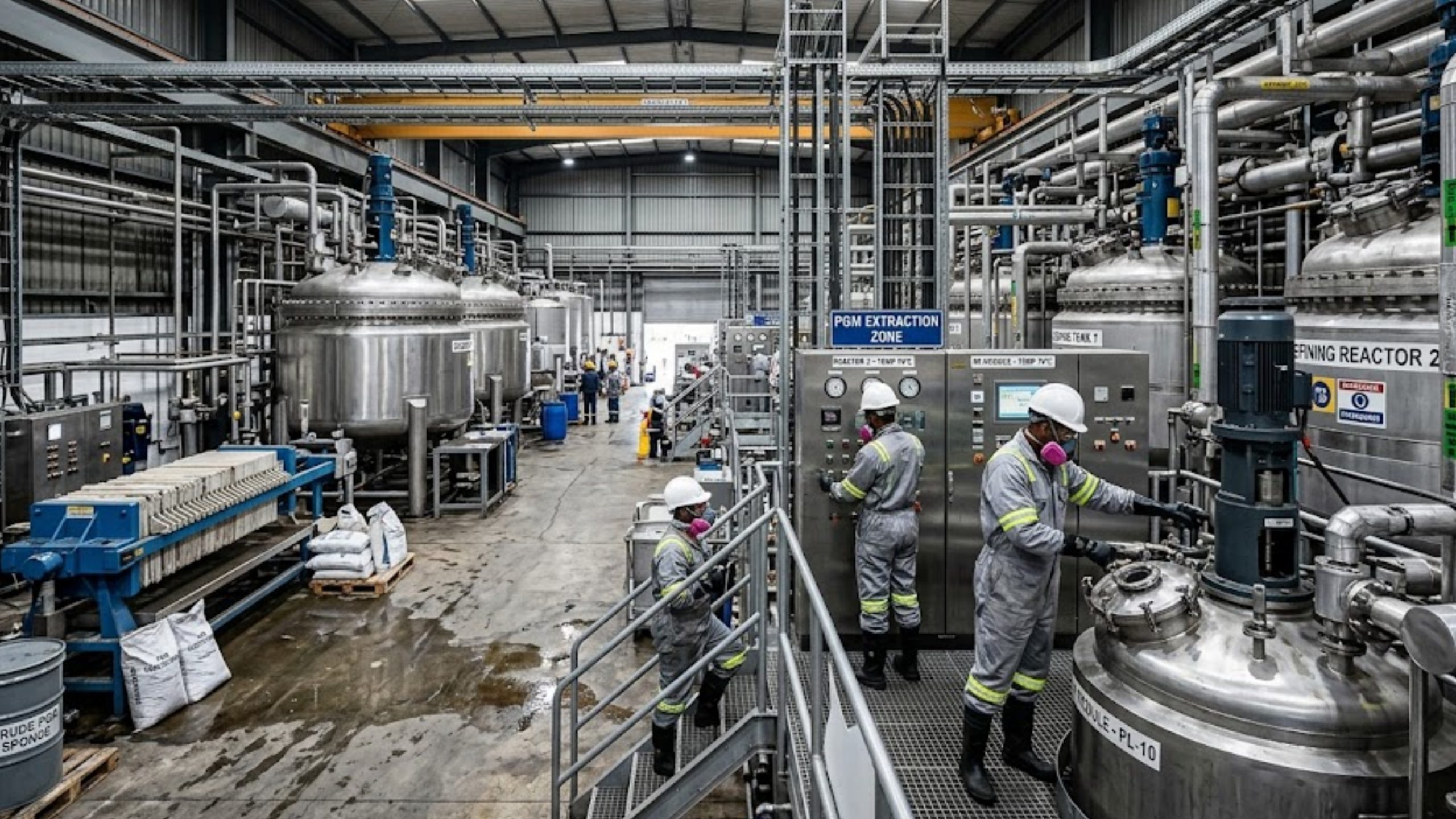
A PGM Refining System for Industrial Use is an integrated processing solution designed to recover and purify platinum group metals from concentrates, slimes, recycled industrial material, smelter intermediates, or mixed precious-metal feed.
These systems usually combine chemical treatment, separation stages, filtration, solvent extraction, precipitation, drying, and final metal recovery. The goal is to produce refined PGM outputs with higher purity, better consistency, and stronger commercial value.
In practical terms, a PGM Refining System for Industrial Use helps convert difficult feedstock into revenue-ready metal products while improving process control and reducing operational losses.
2. Why PGMs Need Specialized Refining
PGMs are not like simple, single-metal ores. They usually occur in complex mineral associations and are often tied up with nickel, copper, iron, sulfur, and other precious or base metals.
That means you cannot rely on a basic processing line and expect clean results. You need a system built specifically for selective recovery and controlled purification.
PGM Complexity in Real Operations
In many mines, the first concentrate still contains several metals. Even after flotation or smelting, the valuable PGMs may remain mixed together. Separating platinum from palladium, or rhodium from base-metal contaminants, takes precision.
This is why a PGM Refining System for Industrial Use typically includes multiple stages rather than one single treatment step. Each stage removes one layer of impurity, similar to peeling an onion until only the high-value core remains.
Why Buyers and Investors Care
A poorly refined product can lead to:
-
Lower sale price
-
Higher penalties from off-takers
-
More reprocessing cost
-
Delayed shipping
-
Inconsistent product quality
A specialized refinery system protects value at the final stage of the mining chain.
3. Key Feed Materials and Input Quality
The performance of any refinery starts with the feed. Not all input materials behave the same, so the plant must be designed around expected feed type and variability.
Common feed sources include:
-
PGM concentrates from flotation plants
-
Smelter matte or intermediates
-
Anode slimes
-
Catalyst recycling feed
-
Low-grade precious metal residues
-
Mixed industrial scrap containing PGMs
Why Feed Characterization Matters
Before plant design, operators should test:
-
Metal grades
-
Moisture content
-
Sulfur levels
-
Chloride compatibility
-
Base metal content
-
Silica and gangue contamination
-
Presence of arsenic or other harmful impurities
If feed quality changes too often without system adjustment, recovery can fall quickly. Good engineering starts with good characterization.
4. Step-by-Step Process Explanation
A PGM Refining System for Industrial Use usually follows a structured flow from incoming feed to final metal product.
Step 1: Feed Reception and Sampling
Material enters the plant and is sampled carefully. This stage sets the foundation for mass balance, accountability, and process control. Accurate sampling prevents disputes and supports reliable recovery calculations.
Step 2: Crushing, Milling, or Conditioning
Depending on feed type, the material may need size reduction or slurry conditioning. This prepares it for efficient chemical attack or physical separation.
Step 3: Leaching or Dissolution
This is where valuable metals are brought into solution. Acids, oxidizing agents, or specialized chemical systems may be used depending on the feed composition.
Step 4: Solid-Liquid Separation
After leaching, the slurry is filtered or thickened. The liquid phase contains dissolved metal values, while the residue contains undissolved solids and waste components.
Step 5: Base Metal Removal
Before isolating PGMs, unwanted metals such as copper, nickel, or iron are removed. This step improves downstream purity and reduces reagent consumption.
Step 6: Selective PGM Separation
This is one of the most important steps in the entire PGM Refining System for Industrial Use. Solvent extraction, precipitation, ion exchange, or other selective techniques are used to separate specific PGMs.
Step 7: Purification and Re-Refining
Recovered PGM streams may need further cleaning to achieve commercial purity targets. This stage improves product consistency.
Step 8: Final Recovery
The metal is recovered as powder, sponge, salt, or another final product form depending on customer requirements.
Step 9: Drying, Calcination, or Melting
Recovered material is dried, calcined, or melted into final saleable form.
Step 10: Packaging and Assay Verification
Final product is packaged, documented, and checked for purity. Accurate assay at this stage is critical for sales and compliance.
5. Pre-Treatment and Feed Preparation
Pre-treatment can strongly influence overall performance. In many cases, the best recovery gains come before refining even begins.
Typical Pre-Treatment Goals
-
Improve leachability
-
Remove moisture
-
Reduce coarse particle size
-
Eliminate unwanted organics
-
Stabilize feed consistency
-
Increase metal exposure to reagents
Examples from Industry
A mine sending wet, poorly sized concentrate into a refinery often sees unstable leaching and filtration performance. By contrast, a feed preparation stage with drying, blending, and particle control can improve overall recovery and shorten process time.
This is why engineers should never treat pre-treatment as a minor add-on. It is a major value driver.
6. Equipment List
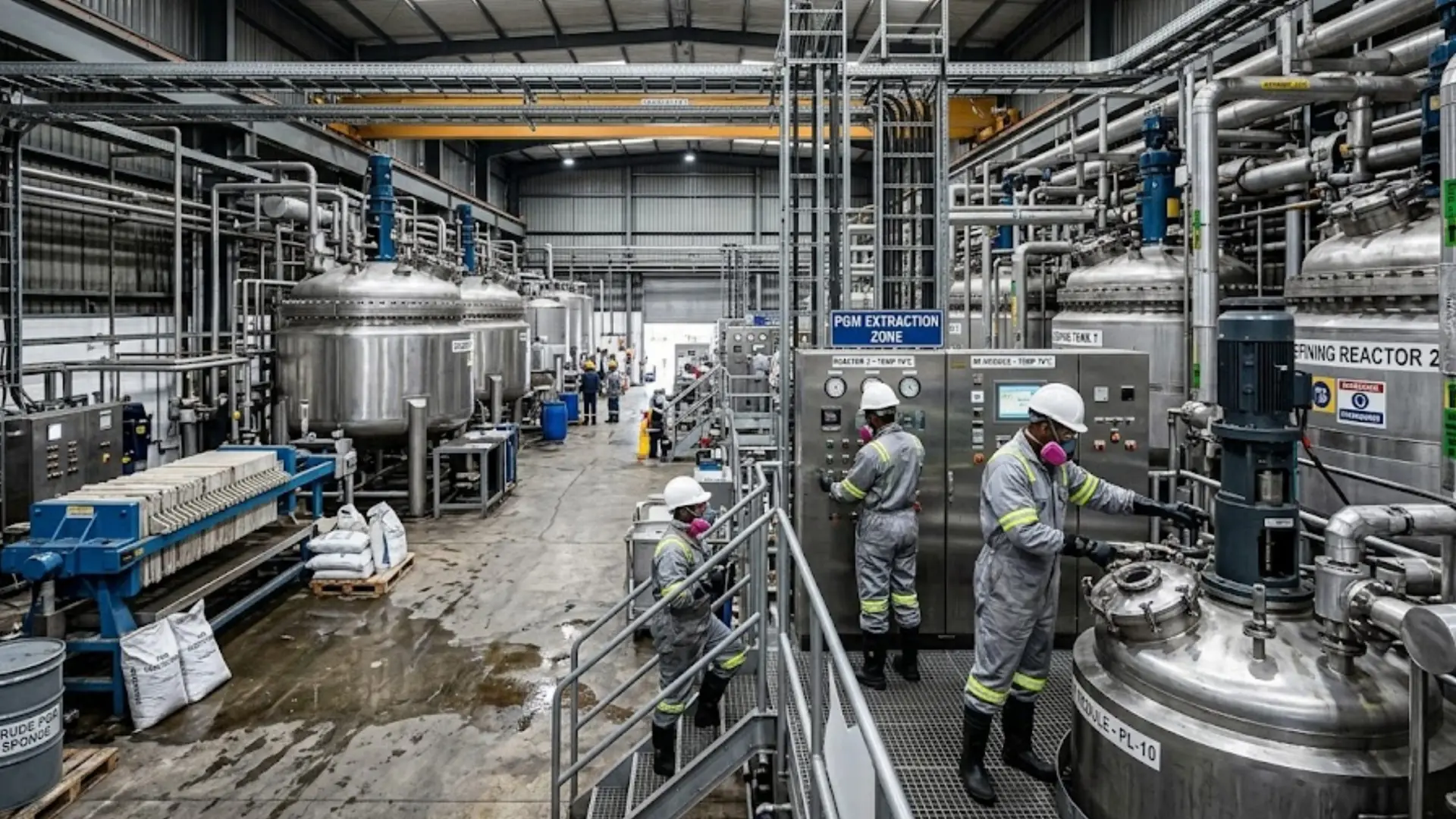
The exact equipment depends on feed type and plant scale, but a standard PGM Refining System for Industrial Use may include:
-
Feed hoppers
-
Belt conveyors or screw feeders
-
Crushers
-
Ball mills or fine grinding units
-
Mixing tanks
-
Leach reactors
-
Agitated vessels
-
Thickeners
-
Filter presses
-
Vacuum filters
-
Solvent extraction units
-
Precipitation tanks
-
Ion exchange columns
-
Dryers
-
Calcination furnaces
-
Melting furnaces
-
Dust collection systems
-
Scrubbers
-
Water treatment units
-
Laboratory assay equipment
-
PLC or SCADA control systems
Why Equipment Quality Matters
Low-cost equipment may reduce initial CAPEX, but poor materials of construction can create corrosion, leakage, and process instability. In refining, equipment reliability directly affects uptime and product purity.
7. Plant Capacity Options (10–1000 TPD)
Choosing the right plant size depends on feed volume, project life, capital availability, and future growth plans.
10–50 TPD: Small Industrial or Pilot-Scale Commercial Plants
These systems are ideal for:
-
Small miners
-
Regional refiners
-
Early-stage projects
-
Demonstration plants
-
Custom toll refining operations
This size is especially useful in markets such as Peru, Bolivia, Mexico, Colombia, Ghana, Tanzania, Indonesia, and the Philippines, where smaller mining operations often need flexible and modular refining infrastructure.
50–200 TPD: Mid-Scale Commercial Operations
These plants suit companies with steady concentrate production and defined customer demand. They offer a balance between manageable capital cost and strong throughput.
200–500 TPD: Large Industrial Plants
This range is common for established producers that need better economies of scale and lower unit processing cost.
500–1000 TPD: Integrated High-Volume Refining Facilities
These plants are designed for major operations or centralized refining hubs. They usually require advanced automation, stronger utility systems, and robust environmental controls.
Capacity Planning Tip
Do not size only for today. Size for your next 3 to 5 years. A modular expansion path often gives better long-term flexibility than building a rigid oversized plant from day one.
8. Energy Consumption Details
Energy is a major operating cost in any refinery. In PGM processing, energy demand depends on grinding, heating, agitation, filtration, drying, and final metal recovery.
Main Energy Consumers
-
Comminution equipment
-
Leach tank agitation
-
Pumps and slurry transfer
-
Filtration systems
-
Dryers and furnaces
-
Ventilation and gas treatment systems
-
Automation and control infrastructure
Typical Energy Pattern
Smaller modular systems often have higher energy cost per ton than large plants, but they offer lower upfront capital and faster deployment. Large plants usually gain better unit efficiency, especially when heat recovery and process integration are included.
How to Reduce Energy Use
Optimize Feed Size
Over-grinding wastes power. Proper size control improves both energy efficiency and chemical performance.
Use Heat Recovery
Where high-temperature stages exist, recovered heat can reduce utility demand.
Automate Reagent and Process Control
Stable operation avoids unnecessary rework, over-heating, and repeated treatment.
For industrial buyers and investors, energy should be measured not only as kilowatt-hours but as cost per unit of recovered metal value.
9. Cost Estimation (Low, Medium, High)
The cost of a PGM Refining System for Industrial Use depends on scale, metallurgy, automation level, environmental systems, and product purity targets.
Low-Cost Range
Suitable for small modular systems or limited-scope refining lines.
Typical characteristics:
-
10–50 TPD
-
Semi-automated
-
Basic control systems
-
Standard utility setup
-
Lower separation complexity
Best for smaller producers, early market entry, or staged investment strategies.
Medium-Cost Range
Used for more stable industrial operations with stronger process control.
Typical characteristics:
-
50–200 TPD
-
Better materials of construction
-
Improved automation
-
More complete environmental systems
-
Enhanced metal separation capability
This is often the most practical range for serious commercial operators.
High-Cost Range
Used for advanced, integrated industrial refining facilities.
Typical characteristics:
-
200–1000 TPD
-
High automation
-
Advanced solvent extraction or purification circuits
-
Strong emissions and water treatment systems
-
High-purity product output
-
Full laboratory and digital monitoring setup
What Drives Cost Up or Down
-
Feed complexity
-
Plant capacity
-
Corrosion-resistant materials
-
Reagent handling requirements
-
Utility availability
-
Environmental compliance standards
-
Product purity requirements
-
Level of automation
A cheaper plant is not always the better plant. The real question is whether the system lowers your cost per recovered ounce or gram of payable metal.
10. ROI / Profitability Analysis
A refinery should not be judged only by build cost. It should be judged by how much additional value it unlocks.
Main Profitability Drivers
-
Higher metal recovery
-
Better product pricing
-
Lower penalties for impurities
-
Reduced transport of unrecovered value
-
Faster turnaround time
-
Improved process control
-
Lower waste and reprocessing cost
Simple ROI Logic
If your refinery helps recover more platinum, palladium, or rhodium from the same feed, the added revenue can be substantial. Even a small increase in recovery may create strong payback because PGMs are high-value metals.
Example Scenario
A mid-sized operator processes concentrate that currently loses part of its PGM value due to incomplete downstream separation. After installing a properly designed refining system, recovery improves, impurity penalties drop, and final product quality becomes more consistent. The result is not just more metal recovered, but better selling terms and more predictable cash flow.
Payback Considerations
A strong project usually shows:
-
Stable feed supply
-
Clear offtake route
-
Reliable assay control
-
Manageable energy and reagent cost
-
Good environmental compliance
-
Modular expansion options
For investors, the best refining projects are those where engineering quality and market demand meet in the same model.
11. Comparison with Traditional Methods
Traditional refining routes may rely on older equipment, more manual handling, weaker process control, or less selective separation steps.
Traditional Methods Often Mean
-
Higher reagent waste
-
More operator dependency
-
Lower consistency
-
Greater contamination risk
-
Slower process cycles
-
Higher emissions or waste burden
Modern System Advantages
A modern PGM Refining System for Industrial Use offers:
-
Better selectivity
-
Better recovery tracking
-
More stable output purity
-
Improved safety
-
Easier scale-up
-
Better environmental performance
A Simple Analogy
Traditional refining can be like using a rough kitchen strainer to separate very fine particles. It catches some material, but a lot passes through or stays mixed. A modern refining system is more like a staged industrial filtration train, where each layer removes a specific impurity until the final product is clean and valuable.
12. Environmental Benefits
Environmental performance is now a core buying and investment factor. A modern refinery system can help reduce environmental burden while improving commercial outcomes.
Key Environmental Benefits
Lower Waste Generation
Better selective recovery means less valuable metal ends up in residue.
Improved Water Management
Closed-loop or semi-closed systems can reduce freshwater demand.
Better Emissions Control
Scrubbers, dust collection, and gas treatment reduce air impacts.
Safer Chemical Handling
Modern layouts improve containment and operator safety.
Reduced Reprocessing
Stable operation reduces off-spec output and repeat treatment.
For companies operating in regions with stricter export, permitting, or community expectations, environmental performance is no longer optional. It is part of project bankability.
13. Real-World Use Cases / Applications
A PGM Refining System for Industrial Use can serve many industrial and mining scenarios.
Mining Companies
Primary producers can use the system to upgrade concentrates or intermediates before sale. This improves payable value and gives more control over the final product.
Custom Toll Refiners
Independent refiners can process feed from multiple small mines and charge service fees. This model works well in fragmented mining regions.
Industrial Recycling Operations
Catalyst and precious-metal residue processors can recover PGMs from industrial waste streams with strong commercial returns.
Integrated Mining and Refining Hubs
Larger groups can combine concentration, smelting, and refining into a single value chain, increasing margin retention.
Regional Opportunity
Countries such as Peru, Bolivia, Mexico, Colombia, Ghana, Tanzania, Indonesia, and the Philippines offer strong potential for smaller modular refining solutions because many miners need local or regional processing capacity rather than relying only on distant large-scale refineries.
14. How to Choose the Right Plant Design
The right plant is not always the biggest one. It is the one that matches your feed, market, budget, and growth plan.
Questions You Should Ask
-
What is the feed mineralogy?
-
What purity level does your buyer require?
-
What is your daily throughput target?
-
How stable is your feed supply?
-
Do you need modular expansion?
-
What utilities are available on site?
-
What are local environmental rules?
-
Will you refine one PGM product or several?
Design Priorities for Buyers
Recovery First
High recovery often matters more than a lower initial equipment quote.
Flexibility Second
Feed may change over time. Your plant should adapt.
Compliance Third
Environmental and worker safety systems protect long-term operations.
Maintainability Fourth
A plant that is hard to maintain becomes expensive very quickly.
15. Why Modular Systems Matter for Emerging Mining Regions
Modular refining is becoming more attractive because many mining operations do not want to wait years for large centralized infrastructure.
A modular PGM Refining System for Industrial Use can offer:
-
Faster deployment
-
Lower first-stage CAPEX
-
Easier transport to remote sites
-
Simplified expansion
-
Better fit for smaller miners
-
Reduced construction complexity
For regions with many small or medium producers, modular designs can bridge the gap between raw concentrate production and value-added local refining.
This is especially relevant where miners want to keep more value inside the country, improve product quality, and reduce the cost of shipping partially processed material over long distances.
Internal Linking Suggestions
To strengthen SEO and improve buyer navigation, add internal links to related pages such as:
-
modular refining plant
-
gold refining plant
-
mining setup guide
You can also build supporting content around topics like reagent systems, emissions control, concentrate upgrading, and precious metal recovery economics.
Conclusion
A PGM Refining System for Industrial Use is more than a processing plant. It is a value-capture system. It helps you recover more metal, improve purity, reduce waste, strengthen compliance, and build a more profitable operation.
Whether you are a mining company, industrial buyer, engineer, or investor, the right refining strategy can turn a difficult feed stream into a reliable commercial product. In a market where recovery, quality, and efficiency directly affect margins, refining is not the final step. It is one of the most important steps.
FAQs
1. What is the cost of a PGM Refining System for Industrial Use?
The cost depends on capacity, feed complexity, automation level, and environmental controls. Small modular plants fall into the lower cost range, while large integrated industrial systems fall into the high cost range. The best way to judge cost is by comparing it to expected metal recovery and long-term operating value.
2. How does the PGM refining process work?
The process usually includes feed preparation, leaching or dissolution, solid-liquid separation, base metal removal, selective PGM separation, purification, final recovery, and drying or melting. Each step removes impurities and improves product value.
3. What plant capacities are available for industrial use?
Capacity options typically range from 10 TPD to 1000 TPD. Small plants are suitable for pilot or regional refining operations, while larger plants are used for integrated industrial projects with steady feed supply.
4. Is a PGM Refining System for Industrial Use profitable?
Yes, it can be highly profitable when feed supply is stable and recovery is strong. Profitability improves when the plant increases payable metal recovery, reduces penalties, improves product purity, and lowers waste or reprocessing costs.
5. How do modern PGM refining systems compare with traditional methods?
Modern systems usually provide better recovery, stronger purity control, better safety, improved environmental performance, and more consistent operation. Traditional methods may still work, but they are often less efficient and less flexible for modern industrial demands.
Read More : Previous Articles