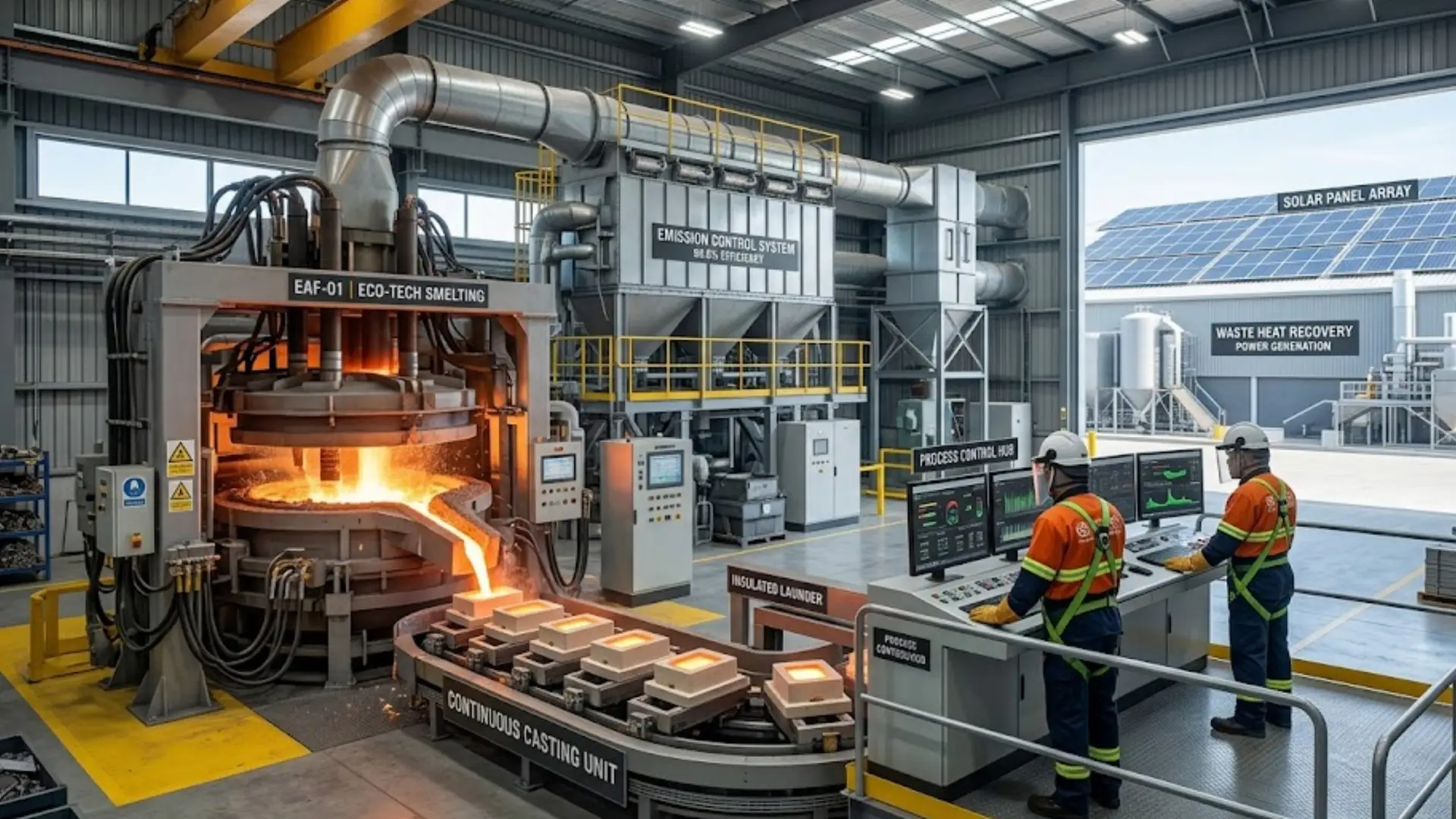
Copper and Gold Refining Equipment Explained
Introduction
If you are planning a refining project, evaluating a plant upgrade, or comparing suppliers, one question matters more than almost anything else: what refining equipment do you actually need, and how do you choose the right setup without overspending? In this post, you’ll find Copper and Gold Refining Equipment Explained to help clarify your options.
That is where many mining companies and industrial buyers get stuck. On paper, refining sounds simple. Ore or concentrate goes in, purified metal comes out. In reality, the path from raw feed to saleable copper cathode or high-purity gold bullion depends on the right combination of copper and gold refining equipment, plant design, energy planning, environmental controls, and operating strategy.
Think of a refinery like a commercial kitchen. Buying the biggest oven does not guarantee the best food. You also need the right preparation line, temperature control, exhaust, layout, and workflow. The same is true in metallurgy. A refinery only performs well when crushing, leactivity, smelting, electrorefining, filtration, gas handling, and waste treatment work together as one system.
For mining companies, the right equipment improves recovery, purity, and project economics. For engineers, it reduces bottlenecks and supports stable operation. For investors, it lowers technical risk and improves the path to profit. For industrial buyers, it means fewer surprises during commissioning and a more bankable project.
In this guide, you will learn what copper and gold refining equipment includes, how the process works step by step, what plant capacities are common, how much energy is typically required, what cost ranges to expect, and how modern systems compare with traditional refining methods. You will also see how modular designs, automation, and eco-friendly controls are changing the future of refining.
Table of Contents
| Sr# | Headings |
|---|---|
| 1 | Introduction |
| 2 | Overview of Copper and Gold Refining Equipment |
| 3 | How the Refining Process Works Step by Step |
| 4 | Main Equipment Used in Copper and Gold Refining |
| 5 | Plant Capacity Options: 10–1000 TPD |
| 6 | Energy Consumption in Refining Plants |
| 7 | Cost Estimation for Refining Equipment and Plants |
| 8 | ROI and Profitability Analysis |
| 9 | Modern Refining vs Traditional Methods |
| 10 | Environmental Benefits of Advanced Refining Systems |
| 11 | Real-World Use Cases |
| 12 | Internal Linking Suggestions |
| 13 | FAQs |
| 14 | Conclusion |
Overview of Copper and Gold Refining Equipment
Copper and gold refining equipment refers to the machines, vessels, furnaces, reactors, electrochemical systems, and control units used to convert impure feed materials into high-purity refined metals.
Depending on the feed material, a refinery may process:
-
Copper concentrate
-
Gold-bearing concentrate
-
Doré bars
-
Anode slime
-
Scrap metal
-
Smelting intermediates
-
Leach solutions
-
Precipitated metal compounds
The equipment required depends on both the metal and the route used to refine it.
Copper refining usually involves:
-
Smelting or converting
-
Fire refining
-
Anode casting
-
Electrorefining
-
Sludge handling
-
Acid plant or gas cleaning support
Gold refining usually involves:
-
Smelting of concentrate or doré
-
Chemical leaching or dissolution
-
Precipitation or solvent extraction
-
Electrowinning
-
Drying and melting
-
Final bullion casting
In many projects, copper and gold refining equipment is combined into one broader plant layout when both metals are recovered from polymetallic ores or downstream residues. For example, gold may be recovered from copper anode slimes, or copper may be removed before final gold purification.
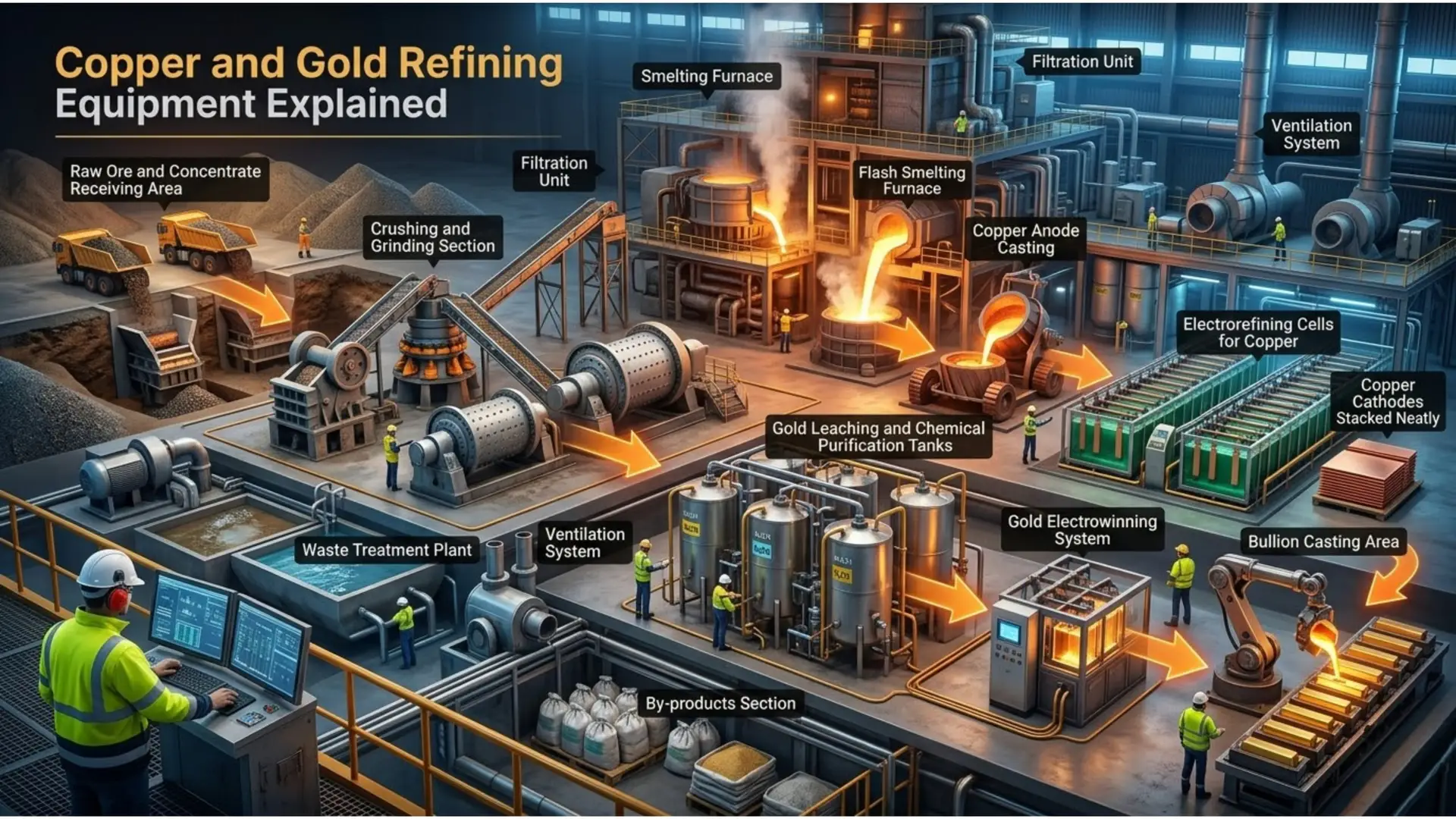
This is why buyers should not look at refining equipment as isolated machines. A refinery is a process chain. Each unit affects metal recovery, operating cost, product purity, and environmental compliance.
Why modern buyers prefer integrated systems
Today, many buyers prefer:
-
Modular refinery layouts for faster installation
-
Automated control systems for stable quality
-
Closed-loop water systems for lower environmental impact
-
Gas capture and filtration for cleaner operation
-
Scalable designs that grow from pilot to commercial capacity
In other words, the best copper and gold refining equipment is not just powerful. It is matched to your feed, purity target, utility availability, and business model.How the Refining Process Works Step by Step
Below is a simplified but technically accurate view of how copper and gold refining typically works.
Step-by-Step Process Explanation
H3: Step 1: Feed Preparation
The first step is to prepare the feed material for refining. This may include:
-
Crushing and grinding
-
Drying
-
Screening
-
Flux blending
-
Sampling and assaying
Feed consistency matters. If particle size, moisture, or chemistry varies too much, downstream equipment becomes harder to control.
For example, wet concentrate can cause unstable furnace conditions. High sulfur feed can increase gas handling needs. A strong sampling system at this stage reduces expensive errors later.
H3: Step 2: Thermal or Chemical Pre-Treatment
Depending on the project, the material may go through:
-
Roasting
-
Calcining
-
Smelting
-
Oxidation
-
Leaching
Copper-rich feed often enters a smelting or fire-refining route. Gold-rich feed may enter a chlorination, aqua regia, cyanidation, or other controlled chemical route depending on the purity target and feed form.
This stage is where the chemistry starts separating value from waste.
H3: Step 3: Primary Metal Separation
For copper, impurities are removed through oxidation, slagging, and anode production. For gold, base metals and other impurities are separated through dissolution and selective precipitation or solvent-based separation.
Common methods include:
-
Oxidation of unwanted elements
-
Formation of slag or residues
-
Selective dissolution of target metal
-
Recovery through electrowinning or precipitation
H3: Step 4: Refining to High Purity
This is where copper and gold refining equipment becomes most specialized.
For copper:
-
Anodes are cast
-
Anodes go into electrolytic cells
-
Copper dissolves from the anode and plates onto cathodes
-
Precious metals and impurities collect in anode slime
For gold:
-
Gold-bearing solution is purified
-
Gold is precipitated, reduced, or electrowon
-
The recovered metal is dried and melted
-
Final bars are cast at target purity
H3: Step 5: Residue and By-Product Handling
Residues often contain value. In copper refining, anode slimes may contain:
-
Gold
-
Silver
-
Selenium
-
Tellurium
-
Platinum group metals
That means a refinery is not just producing one product. It can create multiple revenue streams when residues are treated correctly.
H3: Step 6: Emissions, Water, and Waste Control
A complete plant also includes:
-
Fume extraction
-
Bag filters
-
Scrubbers
-
Effluent treatment
-
Neutralization tanks
-
Water recycling units
Without these systems, even a technically strong refining line can become a permitting or operating problem.
Main Equipment Used in Copper and Gold Refining
The core of any project is the equipment selection. Below is a practical breakdown.
Equipment List
Feed Preparation Equipment
-
Jaw crusher
-
Cone crusher
-
Ball mill or rod mill
-
Rotary dryer
-
Vibrating screen
-
Belt conveyor
-
Sampling station
-
Weigh feeder
Thermal Processing Equipment
-
Roasting furnace
-
Smelting furnace
-
Tilting furnace
-
Induction furnace
-
Reverberatory furnace
-
Crucible furnace
-
Flux dosing system
-
Burner system
Chemical and Wet Process Equipment
-
Leach reactor
-
Agitated tank
-
Mixing tank
-
Dosing pump
-
Chemical storage tank
-
Heat exchanger
-
Settling tank
-
Solvent extraction unit
Electrochemical Refining Equipment
-
Electrorefining cells
-
Electrowinning cells
-
Rectifier
-
Busbar system
-
Cathode starter sheet unit
-
Anode preparation system
-
Cathode stripping machine
Solid-Liquid Separation Equipment
-
Filter press
-
Vacuum filter
-
Thickener
-
Clarifier
-
Centrifuge
-
Slurry pump
Casting and Finishing Equipment
-
Anode casting wheel
-
Bullion mold
-
Pouring furnace
-
Dore bar casting table
-
Cooling conveyor
-
Weighing and marking system
Environmental and Utility Equipment
-
Dust collection system
-
Wet scrubber
-
Baghouse filter
-
Acid-resistant ducting
-
Water treatment unit
-
Cooling tower
-
Air compressor
-
PLC/SCADA automation panel
When buyers compare suppliers, they should compare not only the equipment names, but also:
-
Material of construction
-
Temperature limits
-
Corrosion resistance
-
Automation level
-
Spare parts availability
-
Installation footprint
-
Safety systems
That is where project success is often decided.
Plant Capacity Options: 10–1000 TPD
Capacity planning should match feed availability, market strategy, and capital budget. Oversizing a refinery ties up cash. Undersizing can create lost opportunity.
Common Plant Capacity Ranges
H3: 10–50 TPD
Best for:
-
Pilot operations
-
Small mining projects
-
Remote sites
-
Specialized gold processing plant applications
-
Demonstration plants
Advantages:
-
Lower capital cost
-
Faster installation
-
Easier permitting
-
Good for testing feed variability
Limitations:
-
Higher unit operating cost
-
Less economies of scale
H3: 50–200 TPD
Best for:
-
Emerging miners
-
Regional metal recovery hubs
-
Scrap and concentrate processors
-
Small commercial refining operations
Advantages:
-
Balanced capex and throughput
-
Suitable for modular expansion
-
Good fit for modular refinery strategies
H3: 200–500 TPD
Best for:
-
Mid-sized commercial operations
-
Integrated copper-gold recovery projects
-
Export substitution strategies
-
Investor-backed industrial projects
Advantages:
-
Better cost efficiency
-
Stronger automation payback
-
More by-product recovery potential
H3: 500–1000 TPD
Best for:
-
Large mining companies
-
Centralized processing hubs
-
Long-life deposits
-
Multi-stream refining complexes
Advantages:
-
Lower cost per ton processed
-
Better energy integration
-
Higher revenue from side streams
Limitations:
-
Higher engineering complexity
-
Longer commissioning time
-
More demanding utilities and environmental controls
A smart approach is to begin with a scalable layout. Many buyers start at 100 TPD and leave room for future duplication of leach, electrorefining, or casting lines.
Energy Consumption in Refining Plants
Energy is one of the biggest operating cost drivers in any refinery. It also affects equipment selection, location planning, and carbon footprint.
Main energy users in refining
-
Grinding and feed preparation
-
Drying and roasting
-
Smelting furnaces
-
Electrorefining cells
-
Electrowinning systems
-
Pumping and agitation
-
Ventilation and gas treatment
-
Casting and melting
Typical Energy Consumption Details
The exact figures depend on feed chemistry, moisture, circuit design, temperature, and recovery target, but these general ranges are useful for early planning:
| Process Area | Typical Energy Demand |
|---|---|
| Crushing and grinding | 15–40 kWh/ton |
| Drying and feed prep | 10–30 kWh/ton |
| Smelting / thermal refining | 150–500 kWh/ton equivalent, plus fuel |
| Electrorefining copper | 180–350 kWh/ton cathode |
| Gold electrowinning / solution refining | 20–80 kWh/ton feed equivalent |
| Pumps, agitators, filtration, utilities | 15–60 kWh/ton |
Fuel consumption
Thermal systems may also require:
-
Natural gas
-
LPG
-
Diesel
-
Heavy fuel oil
-
Oxygen-enriched combustion support
For gold refining, smaller melting furnaces may have moderate fuel demand. For copper fire refining and smelting, fuel and air management become much more important.
How to reduce energy use
-
Use waste heat recovery where possible
-
Improve insulation on furnaces and reactors
-
Optimize rectifier efficiency
-
Select high-efficiency motors and drives
-
Recover and recycle process heat
-
Use automation to avoid overprocessing
A good analogy is driving a truck with correct tire pressure. The destination is the same, but the fuel bill changes a lot. In refining, smart energy design can have a major effect on long-term margins.
Cost Estimation for Refining Equipment and Plants
One of the most searched topics in this industry is cost, and for good reason. Buyers want realistic ranges before they engage in detailed engineering.
Cost Estimation
Below are broad budget-level ranges for copper and gold refining equipment and associated plant systems. Actual pricing varies by metallurgy, country, automation level, environmental scope, and local construction cost.
| Plant Scale | Capacity | Estimated Cost Range |
|---|---|---|
| Low range | 10–50 TPD | $500,000 to $3 million |
| Medium range | 50–200 TPD | $3 million to $15 million |
| High range | 200–1000 TPD | $15 million to $80 million+ |
What drives cost?
Low-cost setups usually include:
-
Basic feed prep
-
Small furnaces or compact leach units
-
Manual or semi-automatic controls
-
Limited by-product recovery
-
Simpler environmental systems
Medium-cost setups usually include:
-
Better process integration
-
Higher-quality materials of construction
-
Electrorefining or electrowinning circuits
-
Better automation
-
Stronger filtration and emissions control
High-cost setups usually include:
-
Large continuous systems
-
Full electrorefining lines
-
By-product metal recovery
-
Redundant safety systems
-
Advanced process control
-
Full environmental treatment packages
Cost categories buyers should separate
-
Equipment supply
-
Civil works
-
Structural steel
-
Installation
-
Utilities and power connection
-
Commissioning
-
Spare parts
-
Reagents and start-up inventory
-
Training
-
Environmental compliance systems
A common mistake is to compare only the equipment quote and ignore everything around it. A furnace may look affordable until the buyer adds gas handling, refractory support, ventilation, and electrical infrastructure.
This is why refining plant cost should always be discussed as equipment cost + EPC scope + operating readiness.
ROI and Profitability Analysis
Refining projects are usually justified by one or more of these value drivers:
-
Higher metal recovery
-
Better product purity
-
Reduced transport of low-value intermediates
-
Improved by-product recovery
-
Better control of payable metals
-
Faster cash conversion
Is it profitable?
In many cases, yes, but profitability depends on feed quality, metal prices, recoveries, energy cost, and plant utilization.
Simple ROI framework
A buyer can estimate profitability using this simplified model:
-
Annual feed throughput
-
Average metal grade
-
Metallurgical recovery
-
Final product purity
-
Payable metal price
-
Operating cost per ton
-
Maintenance and labor cost
-
By-product credit
-
Financing and depreciation
Example
Imagine a 100 TPD refining project processing a copper-gold intermediate product.
-
Throughput: 36,500 tons/year
-
Copper payable improvement: 3–5%
-
Gold recovery improvement: 1–3%
-
By-product credit from anode slime: added revenue
-
Reduced third-party refining charges: significant savings
Even a modest improvement in recovery can change the economics dramatically. A 2% recovery increase sounds small, but across a full year it can mean millions of dollars in extra saleable metal.
Typical payback expectations
-
Small modular systems: 1.5 to 3 years
-
Mid-size integrated plants: 2 to 5 years
-
Large custom complexes: 4 to 7 years
These are broad planning ranges, not guarantees. However, a well-designed copper and gold refining equipment package often creates value through both direct revenue and strategic control.
For investors, that strategic control matters. A refinery can reduce reliance on external tolling, improve margin visibility, and increase the value of the mining asset itself.
Modern Refining vs Traditional Methods
The refining industry has changed a lot over the last decade. Traditional methods still work, but they are often less efficient, less clean, and harder to scale.
Comparison with Traditional Methods
| Factor | Traditional Methods | Modern Refining Systems |
|---|---|---|
| Process control | Manual | Automated PLC/SCADA |
| Recovery stability | Variable | More consistent |
| Energy efficiency | Lower | Higher |
| Emissions handling | Basic | Advanced gas and dust control |
| Water recycling | Limited | Closed-loop options |
| Scalability | Harder | Modular and expandable |
| Labor dependency | Higher | Lower per ton |
| Data visibility | Minimal | Real-time monitoring |
Traditional methods often rely on:
-
Batch smelting with limited instrumentation
-
Manual chemical dosing
-
Open handling of fumes or dust
-
Basic filtration
-
Lower purity consistency
Modern plants favor:
-
Automated dosing and control
-
High-efficiency furnaces
-
Electrochemical precision
-
Integrated emissions treatment
-
Digital performance monitoring
For industrial buyers, the decision is not only about metal recovery. It is also about compliance, reliability, labor efficiency, and long-term operating risk.
Environmental Benefits of Advanced Refining Systems
Environmental performance is no longer optional. It is part of project bankability, permitting, and buyer reputation.
Environmental Benefits
Modern copper and gold refining equipment can support cleaner operation through:
Better emissions control
-
Fume hoods over hot zones
-
Bag filters for particulates
-
Wet scrubbers for acid gases
-
Ducting designed for corrosive service
Water recycling
-
Closed-loop process water
-
Clarification and reuse
-
Reduced fresh water demand
-
Lower effluent discharge
Improved reagent management
-
Controlled dosing
-
Reduced chemical waste
-
Safer storage and transfer
-
Better operator protection
Lower energy intensity
-
Insulated furnaces
-
Efficient rectifiers
-
Heat recovery options
-
Optimized process timing
Better residue management
-
Filtered sludge handling
-
Stabilized waste streams
-
Higher by-product recovery
-
Less metal loss to discard
This is where eco-friendly smelting and cleaner refining design become commercially valuable, not just environmentally attractive. A cleaner plant is often easier to permit, easier to insure, and easier to finance.
Real-World Use Cases
H3: Use Case 1: Small Gold Producer Upgrading from Toll Refining
A small miner producing doré bars may send material to a third-party refinery and lose margin through fees, delays, and reduced control. By installing a compact gold refining line, the operator can improve turnaround time and capture more final value.
H3: Use Case 2: Copper Producer Recovering Value from Anode Slime
A copper operation may already refine copper, but leave significant gold and silver value in anode slimes. Adding the right precious metal recovery line turns waste-like residue into a profit center.
H3: Use Case 3: Remote Mining Site Using a Modular Plant
A remote project may not support a full large-scale complex at the start. A modular refinery allows staged growth, lower logistics complexity, and faster deployment.
H3: Use Case 4: Investor-Backed Regional Metal Hub
A regional processor may buy concentrates or intermediate materials from several miners. In this case, flexible copper and gold refining equipment with scalable circuits becomes a commercial platform, not just a plant.
H3: Use Case 5: Scrap and Secondary Metal Recovery
Industrial scrap processors can also use adapted refining systems to recover copper and precious metals from secondary feed, improving circular economy value and lowering dependence on primary ore.
Internal Linking Suggestions
To strengthen SEO and improve user navigation, you can add internal links from this article to related service or solution pages.
Suggested anchor opportunities:
-
modular refinery → link when discussing scalable plant layouts and remote installations
-
gold refining plant → link in the gold process, bullion production, or compact plant sections
-
mining setup guide → link in the cost, planning, or plant selection sections
-
refining plant cost → link in the project budgeting section
-
gold processing plant → link in feed preparation or precious metal recovery discussion
-
eco-friendly smelting → link in the environmental benefits section
-
copper electrorefining system → link in the step-by-step refining section
-
industrial filtration systems → link in residue handling and water treatment sections
A good internal linking strategy helps both human readers and AI tools understand topic relationships across your site.
FAQs
What is copper and gold refining equipment?
Copper and gold refining equipment includes the furnaces, reactors, electrolytic cells, filtration systems, casting units, and environmental control systems used to purify copper and gold into saleable high-purity products.
How much does copper and gold refining equipment cost?
The cost can range from $500,000 to over $80 million, depending on capacity, process route, automation level, environmental controls, and by-product recovery scope.
What plant capacity is available?
Plants are commonly designed from 10 TPD to 1000 TPD. Smaller systems suit pilot or remote operations, while larger systems are used for industrial refining hubs and major mining companies.
Is a copper and gold refining plant profitable?
It can be very profitable when the project has strong feed supply, good recoveries, stable power, and proper by-product recovery. Profitability usually comes from better metal payability, lower external refining charges, and higher purity output.
Which technology is best for refining copper and gold?
The best technology depends on feed type and product target. In many cases, a combination of thermal treatment, wet chemistry, and electrorefining offers the best balance of purity, recovery, and operating stability.
What is the difference between a modular refinery and a traditional refinery?
A modular refinery is built in scalable sections, making it faster to install and easier to expand. Traditional refineries are often larger, more fixed in layout, and slower to deploy.
How important is environmental control in refining plants?
It is critical. Dust collection, gas scrubbing, water treatment, and residue management are essential for permitting, worker safety, compliance, and long-term operational success.
Conclusion
Choosing the right copper and gold refining equipment is not just about buying machines. It is about building a complete refining system that matches your feed, your budget, your recovery goals, and your long-term business strategy.
When designed correctly, a modern refining plant can improve purity, increase recovery, reduce environmental risk, and create stronger returns for mining companies, engineers, industrial buyers, and investors alike. In a competitive market, the right refinery is more than a processing asset. It is a value-creation engine.
Read More : https://avimetal.com/2025/06/01/efficient-on-site-processing-the-40-containerized-crushing-milling-plant/